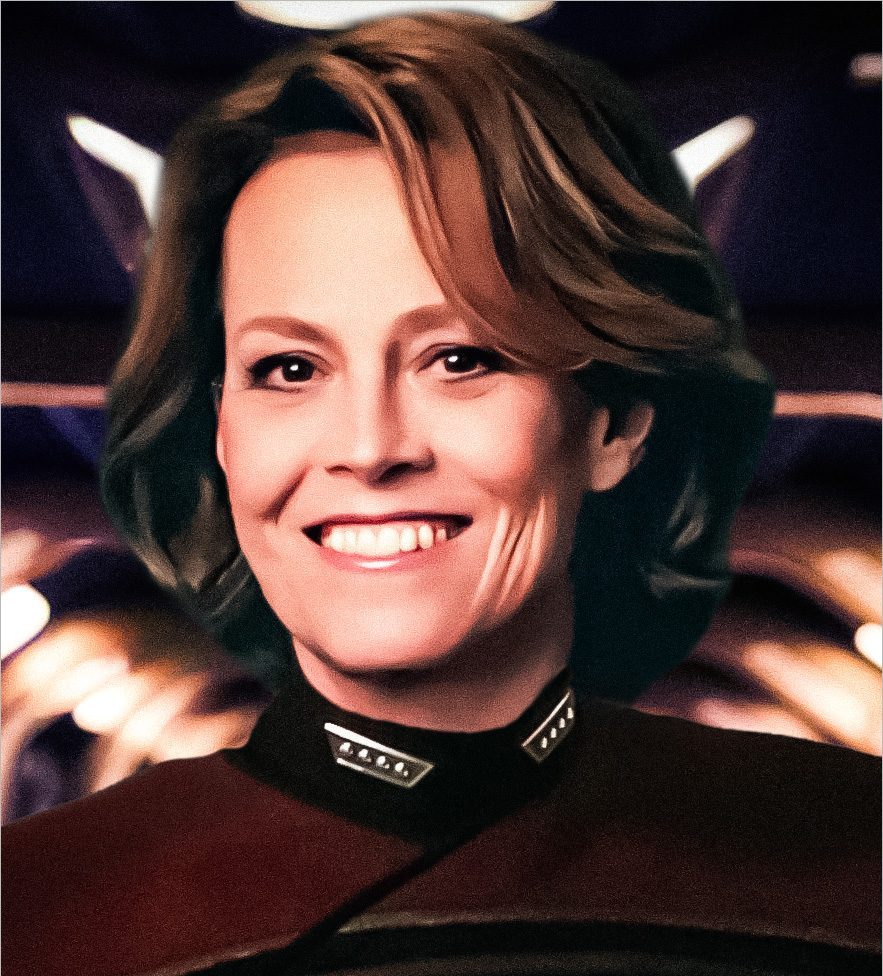







“Chief Petty Officer Azira Corin, sir.”
“Thank you, Mister Florrick.”
Florrick stepped back, and the doors closed, and McCallister was left looking at a woman who had stopped two paces inside the room and was taking an unhurried inventory of it.
She wore command red, immaculately turned out, with silver hair cut short and swept back from a face that had done a great deal of living and kept every bit of the record. The Trill markings ran from her temples down her throat and disappeared into her collar. She had no PADD, no folder, nothing in her hands, and she looked at the wall display rather than at him.
“Chief Corin.”
“Admiral McCallister.” She did not sit. “Fourteen ships.”
“Fourteen.”
“You’ve got the Pythagoras listed above the Destiny. Alphabetically, she sits below. By tonnage, she sits below. I can’t work out the ordering at all.”
McCallister looked at his own display for a moment. “It’s the order they were assigned to their division and squadron.”
“Ah.” She considered that. “That’s a reasonable system. It’s not an obvious one. Anybody coming into this room cold will spend four seconds trying to work it out and then stop trying, which means they’ll stop reading the board.” She finally looked at him. “That’s not a criticism. It’s an observation about boards.”
“Please sit down, Chief.”
She sat.
McCallister had read her file three times. Between his last meeting and now, he’d also read Florrick’s report on her, which ran to nine lines and included the sentence, “She did not ask me a single question about the Admiral,” which Florrick had evidently thought significant, and McCallister was inclined to agree.
“You’ve been at the Grazer annex five years.”
“Four years and seven months.”
“The record says five.”
“The record rounds.” She folded her hands in her lap. “Four years and seven months.”
“Doing what, exactly? The post is listed as administrative coordination, which could mean anything.”
“It means I run the campus. Rotations, berthing, instructional scheduling, supply, the Commandant’s calendar, three standing committees and the disciplinary docket.” She paused. “It also means I have an office with a wall I cannot hang anything on, for reasons nobody has ever explained to me.”
“Do you like it?”
“No.”
The answer came without any hesitation whatsoever, and without any apparent awareness that it was an unusual thing to say in an interview.
“Why not?”
“Because it is a very good job for somebody who is finished, Admiral, and I am not finished.” She said it evenly. “Grazer is where Starfleet puts people it has decided are reliable. I have been reliable for a very long time. I would like, before I am done, to be useful again, which is a different thing and harder to arrange.”
McCallister sat back.
“Ensign Florrick came a long way to see you.”
“He did. In appalling weather, and he was very polite about it, and he was the first person in four years and seven months to come and find me rather than send me a form.” She tilted her head slightly. “You sent an ensign to recruit your own executive yeoman. I have thought about that a great deal on the journey here, and I still don’t know whether it was clever or careless.”
“Which do you think?”
“I think you’ve had a number of lists from Starfleet Personnel and rejected all of them, and I think by the time you’d finished rejecting the last one you had stopped believing that Personnel knew what you wanted.” She shrugged very slightly. “So you asked the person who, from what I’ve been told, will now sit outside your door all day and watch you work. That’s either the best decision you’ve made this month or an extremely expensive way of avoiding paperwork.”
“You’ve a low opinion of Personnel.”
“I have a specific opinion of Personnel. They are extremely good at matching a service record to a post description and have no mechanism whatsoever for the question you were actually asking, which was not ‘who can do this job’ but ‘who can do this job for me.’“ She paused. “I should say at this point that I don’t know whether I’m one of them.”
“That’s an odd thing to tell me.”
“It’s a true thing to tell you. I assume you’d rather have the true one.”
They went on for some time.
“A captain comes to my door,” McCallister said. “Says it’s urgent, says it won’t wait, and I’m in the middle of something that genuinely can’t be interrupted. What do you do?”
“That depends entirely on the captain.”
“Say it’s Fleet Captain Cambil, my deputy.”
“Then she’s already decided it’s urgent, and she’s right about three times over, and I’d interrupt you.” Corin did not hesitate over any of it. “Say it was somebody else and I’d ask what the matter was, and if the answer began with the words ‘it’s about the schedule,’ they would not be seeing you today.”
“And if they insisted?”
“They’d still not be seeing you today.”
“Some of them outrank you by a considerable margin, Chief.”
“All of them outrank me by a considerable margin, Admiral; that is rather the nature of the post.” She said it quite mildly. “If you want somebody who weighs every request against the pips on the person making it, you want a clerk, and Starfleet Personnel will find you an excellent one. A yeoman who applies a single rule to that question is useless inside a month, because every captain in your flotilla will have worked out the rule by week three and started gaming it.”
McCallister made a note of precisely nothing and asked, “What’s the most important part of the job?”
“Keeping your calendar honest.”
“That’s not the answer most people give.”
“No. Most people say access, or priorities, or managing the flow of information, which are all the same answer dressed differently, and all of them are downstream of the one I’ve given you.” She shifted slightly in the chair. “May I be blunt about this, or would you rather I weren’t?”
“Be blunt.”
“Most senior officers’ calendars are a work of fiction. Not deliberately. It happens because the person maintaining it is frightened of them.” Corin’s hands stayed folded. “So the forty-minute meeting that will take ninety minutes is entered as forty, because telling an admiral their afternoon doesn’t fit is unpleasant. And the admiral looks at the calendar and sees a day that is achievable, and it is not achievable; it has never once been achievable, and by sixteen hundred hours they are behind and irritable and making decisions faster than they ought to be. And everybody blames the day.” She paused. “The day is not the problem. The problem is that somebody wrote a lie on it at nine o’clock that morning and nobody wanted to be the one to say so.”
McCallister was quiet for a second.
“The yardmaster here at Avalon asked for twenty minutes this morning.”
“And he’ll take fifty.”
“He always takes fifty.”
“Then he should be entered as fifty, Admiral, and if he finishes in twenty, you will have been handed half an hour you weren’t expecting, which is the single most valuable thing anybody can give a person in your position.” She looked at him. “I’d also want to know who put him down for twenty, and whether they did it because he asked for twenty or because the board looked better that way.”
“Mister Florrick entered it as twenty. He told me it would be fifty while he was doing it.”
“Then Mister Florrick is honest, and the calendar is not, and those two facts are going to fight each other eventually.” A small movement at the corner of her mouth. “I’d back the calendar. The calendar usually wins. Plus Mister Florrick has a lot in understanding how to maintain an admiral’s calendar.”
“Do you have any questions for me?”
“Several. Most of them are about the job, which I’d rather ask after you’ve decided, because asking them now looks like enthusiasm and I’d rather not mislead you.”
“Mislead me how?”
“I haven’t decided whether I want it.” She looked at him levelly. “I thought you should know that before you spend any more of your afternoon.”
“Most people would have waited until they were offered.”
“Most people would, yes. I’ve found it causes a great deal of trouble later.” Corin smoothed one hand along the arm of the chair. “I’ve watched a man take a post he didn’t want because he couldn’t think how to say so in the room. He was unhappy for six years and so was everybody who worked for him. I’d rather be rude now.”
McCallister looked at the woman sitting across from him and thought, not for the first time that afternoon, that she was doing an extraordinarily thorough job of talking herself out of a post she had travelled four days to be considered for.
“Chief,” he said. “Why did you leave Starbase Two-One-Nine?”
And there, for the first time in forty minutes, she stopped. It was not a long pause. It was simply the first one.
“It’s in the file,” she said.
“The file says transferred at the request of the commanding officer. It doesn’t say why.”
“No. It wouldn’t.” Corin’s hands were still in her lap. “I was Captain Hart’s yeoman for eleven years. I was good at it, and he knew I was good at it, and he never once said so, which is neither here nor there, because he never said so to anybody.” She let out a small, dry breath. “In ninety-nine, his son left the station for the Academy. Parker. I believe you know him. He appeared attached to Mister Florrick on their visit to see me. Well, I’ve known Parker since he was a boy; he spent much of his childhood in my office, largely because his father’s was not a comfortable place to be. There was a reception on the promenade the week he shipped out. A number of the senior staff were there.”
“Go on.”
“Captain Hart said, in front of perhaps forty people, that he expected the boy would fail his first year and be back on the station by the following summer. He said it as a joke. Several people laughed.” Her voice did not change. “And I told him, in front of the same forty people, that he was the only person on that station who believed it, and that if his son came back by the following summer it would be because his father had spent eighteen years making certain he had nowhere else to feel welcome.”
McCallister said nothing.
“It was a gross breach of discipline,” Corin said. “I’d like that noted. I was a chief petty officer addressing a captain in public, and everything that happened to me afterwards was entirely within his rights, and most of it was within regulation. He had me transferred within the month. I have never contested it, and I don’t intend to start now.”
“Why did you say it?”
“Because somebody was going to have to, eventually, and nobody else was going to.” She looked at her hands. “And because I have been a parent four times, Admiral. Three of my previous hosts and myself. There is a particular thing a parent does when they are frightened their child will be better than them, and I have watched it done from the inside, and I have never once seen it do anything but damage. I was not going to stand on a promenade and listen to it being done to that boy and say nothing.”
There was a silence.
“I had two sons of my own,” she said. “And a husband. They were on Mars on First Contact Day in eighty-five.”
McCallister’s hands went very still on the table.
“My husband worked in the orbital yards, and the boys had gone up to meet him for the afternoon as a surprise.” She said it the way people say things they have long ago stopped expecting anybody to respond to. “So when I say I understand what a father is throwing away when he talks about his son like that, Admiral, I would like you to understand that I am not speaking theoretically.”
“No,” said McCallister. “I can see that.”
“Mm.” She straightened slightly. “That is the whole of it. You asked why I left Two-One-Nine, and the answer is that I was removed for insubordination and I would do it again, which I appreciate is not a quality most flag officers look for in the person managing their diary.” She paused again and composed herself. “One thing. And I’d ask it whatever you decide.”
“Go on.”
“Parker doesn’t know.” For the first time, something in her face moved. “He was already away when it happened. Nobody has ever told him, and his father certainly won’t have, and I have no intention of ever telling him myself. He came all the way to Grazer with your ensign and sat in my office and was pleased to see me, and he does not know, and I would like it to stay that way.”
“Why?”
“Because he would feel he owed me something.” She shook her head once. “He doesn’t. He was a boy, and his father was unkind about him in public, and somebody said so. That isn’t a debt. If he knew, he’d carry it about with him, and he’s got quite enough of his father to carry already.”
McCallister looked at her for a long moment.
“He won’t hear it from me.”
“Thank you, sir.” She inclined her head. “Then that’s everything I had.”
“When can you start?”
Corin opened her mouth to say something else entirely, and then stopped. “…I’m sorry?”
“When can you start?”
She blinked.
“Admiral, I’ve just told you I was transferred off a starbase for insubordination.”
“You have.”
“In public. To a captain.”
“I was listening.”
“And I’ve told you I don’t know whether I want the post, and I’ve been fairly rude about your display board, and I corrected you on your own personnel file inside the first ninety seconds.” She was, McCallister noted with some satisfaction, entirely at sea. “I have been doing this a long time. That was not a good interview.”
“It was an extremely good interview. It simply wasn’t a good audition, which is a different thing, and I’ve sat through eleven of those this month and hated all of them.” He stood and went round to the front of the desk. “I’ve got a flotilla of fourteen ships, a staff I’m still assembling, four new senior officers I met for the first time an hour ago and a yard period that ends in a few weeks. What I need is somebody who will tell a captain no, tell me no, and keep the diary honest. I don’t need somebody who wants to impress me. I’ve got an ensign outside who wants to impress me, and he’ll grow out of it.”
Corin was silent.
“You said you wanted to be useful again,” McCallister said. “I’m offering you the job, Chief. It isn’t a reward, and it isn’t a kindness, and it’s going to be a great deal of work done badly for the first six months while we build the thing we’re meant to be running. Mister Florrick was fairly clear with you about that, I understand.”
“He was. He led with it.” Something was happening at the corner of her mouth. “I thought at the time that it was either very honest or a very good tactic.”
“It was honest. He hadn’t got as far as tactics.”
“No. That’s rather what I concluded.” She stood, smoothed down the front of her uniform jacket, and McCallister watched the last forty minutes being filed away somewhere and the next thirty years coming out to meet it. “Three days. I’ve a quarters allocation to arrange at Grazer and a disciplinary docket to hand over, and I will not leave it in a state.”
“Three days is fine.”
“And I shall want a meeting with Fleet Captain Keating as soon as she reports, because if I’m to run your office and she’s to run your staff then one of us needs to find out early which of us is wrong about the other, and I would rather it were done in week one than month four.”
“That,” said McCallister, “is the most alarming sentence anybody has said to me today.”
“Yes.” Azria Corin considered him for a moment with something that was not quite a smile. “You’ll get used to it.”