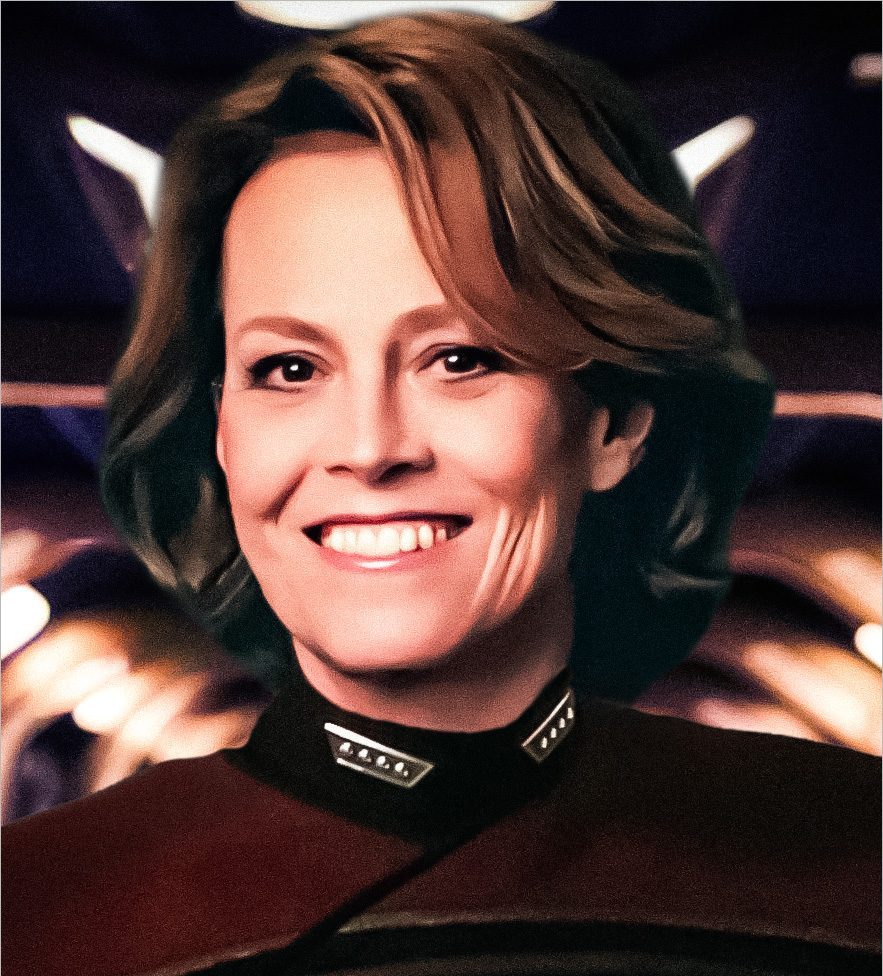







“Fourteen hundred, the meeting with both captains and both first officers of the Leto and the Hypatia. Fifteen hundred, your interview with Chief Petty Officer Corin. Sixteen thirty, the yardmaster, who has asked for twenty minutes and will take fifty.”
“He always takes fifty.”
“He always asks for twenty, sir.” Florrick fell into step on McCallister’s left, PADD held at the angle of a man who had memorised everything on it and was carrying it for reassurance rather than reference. “Seventeen thirty is clear. Eighteen hundred you’re expected aboard the Odyssey, and Captain Reyas asked me to tell you that if you’re late again she’ll start dinner without you.”
“Did she use those words?”
“More or less.” He paused. “Actually, she used shorter ones, sir.”
McCallister smiled at that and lengthened his stride slightly, which Florrick matched without appearing to notice he was doing it. The upper concourse of Brahms Station ran for two hundred metres along the station’s outer curve, wide and bright and immaculately kept, the deck plating polished to the point where the overhead lighting laid a long soft stripe down the middle of it. Yard personnel moved past them in ones and twos, in operations gold and engineering yellow, and every one of them stepped aside at the sight of the two boxed-up pips on either side of McCallister’s collar along with the golden trip across his uniform.
McCallister had not entirely got used to that. He suspected he never would. Now he was a proper admiral and not a commodore; it brought some sort of extra change. One he could not yet describe.
“The quarters allocation,” he said. “Did it clear?”
“It did, sir. This morning.” Florrick did consult the PADD this time. “Fleet Captain Keating and Captain Mercer are assigned adjoining quarters on deck eight, with the internal bulkhead removed and the two spaces configured as one to their specification. Quartermaster queried it twice. I sent the configuration request back both times with the regulation citation attached.”
“Both times.”
“Yes, sir.”
“Good man.” McCallister glanced sideways. “They’ve been married for some time now, Mister Florrick. I’d rather not have them filing a grievance in their first fortnight.”
“That’s more or less what I said to the quartermaster, sir.”
They came to the long viewport that ran the length of the concourse’s outer wall, and McCallister slowed, because he always did, and because it was worth it.
Avalon Fleet Yards lay spread out beneath and around them in the hard clean light of the system’s primary. Gantries and construction frames stretched away in every direction, strung with work lights, crawling with tenders and workbees. Three Reliant-class hulls sat in a row in the middle distance, half-plated, their frames still open to vacuum. In the furthest slip sat something enormous and unfinished, all scaffold and shadow, though enough of her shape was assembled now to make out what she was going to be. A Noble-class explorer, brand new, straight off the frame.
And directly below them, close enough to see the crews working along her dorsal spine, the Odyssey.
Seventeen years out of the yard and most of the way through the second refit cycle of her life, and she wore it well. The yard had her hull plating open along two sections amidships, and a cradle rigged over her port nacelle, but she sat in her slip the way she always sat, like something put there on purpose by people who knew what they were doing.
McCallister stopped for a moment. So did Florrick.
“Never gets old, sir?” The ensign asked, admiring the view with his superior.
“No. It doesn’t.” He put his hands behind his back. “Every hull in this flotilla is sitting in a drydock in this system right now, being put right. Fourteen ships, including the Telemachus, all of them opened up at once. I don’t expect to see that again in my career, and I find I’m rather enjoying it while it lasts.”
“Yes, sir. Also, I ran the berthing schedule this morning. Three times.”
McCallister looked at him.
Florrick was twenty-four years old, in command red that still held the sharp creases of something recently replicated, and he had shaved with enough care this morning that the stubble he had been cultivating for the last month was trimmed to within a millimetre of Starfleet’s tolerance rather than beyond it. His hair was pushed back. His collar was correct. He was holding the PADD slightly too tightly.
McCallister had been an ensign once, a very long time ago, in a corridor not unlike this one, holding a PADD rather too tightly and walking half a step behind Captain Brooke Fontana-Adelaide.
She had never once told him he was doing well. Instead, she’d handed him things slightly beyond him, then refused to take them back when he faltered, and then remarked in passing, months later, that she had never doubted he would manage. He had not understood what she was doing at the time. He had been well into his thirties before he worked it out, and by then she was gone.
Everything he had turned out to be, he thought, had started in a corridor with that woman deciding not to make it easy for him.
He intended to do exactly the same for this one.
“Three times is twice more than necessary,” he said, “which means you found something.”
“Sir?”
“You wouldn’t have run it a third time unless the second one turned something up. What was it?”
Florrick hesitated for half a second. “The Hypatia and the Astraeus had stores runs booked against the same yard tender on the same morning. It’s not a conflict exactly; the tender could have serviced both docks in the window, but the Astraeus is taking on four hundred crates of instructional materials and the Hypatia’s loading laboratory consumables that need a controlled environment the whole way across. One of them would have to wait in vacuum while the other was unloaded. So I moved the Astraeus to the following morning.”
“On your own authority.”
“…Yes, sir.” Slightly smaller. “I can move it back.”
“You will not move it back.” McCallister started walking again. “You’ll do that again next time, and you won’t ask me first, and when somebody complains, you’ll send them to me. Which nobody will, because you were right.”
Florrick caught up. He did not say anything, but McCallister could hear him deciding not to say several things, which was its own kind of progress.
“You escorted them up from the transporter room,” McCallister said. “The four of them.”
“I did, sir.”
“What did you make of them?”
Another half-second. It was the same half-second as before, and McCallister noted it and let it pass without comment.
“They were all very punctual, sir,” Florrick said.
“Mm.”
“Captain Rovak arrived eleven minutes before his transport window and waited in the transporter room rather than delay it. Commander Knelzi asked me four questions about the station’s environmental systems that I couldn’t answer, then answered two of them herself. Commander Teran asked whether I’d eaten.” Florrick’s expression did not change at all. “Captain Thran asked whether you were as difficult to work for as everyone says.”
“And?”
“I told him I couldn’t comment on that, sir.”
“That’s a diplomat’s answer.”
“It’s an ensign’s answer, sir.”
McCallister laughed properly, and something in Florrick’s shoulders came down about a centimetre, which had been the object of the exercise.
They stopped at the conference room doors.
“Anything else I ought to know?”
And there it was a third time: the pause, the small movement at the corner of the mouth, a sentence assembled and then put away unspoken. Florrick was thinking that these four were nothing whatever like the people his admiral had spent the last month collecting, and he was not going to say a word of it, because he was a twenty-four-year-old ensign and they were two captains and two commanders and it was not remotely his place.
Good, McCallister thought. He’ll say it in six months. Let him get there himself.
“No, sir. Nothing that isn’t in the files.”
“Then I’ll see you at fifteen hundred.”
“Yes, sir.” Florrick stepped aside and came to attention without quite meaning to. “Good luck, sir.”
McCallister paused with his hand raised to the door panel.
“That’s an unusual way to end a briefing, Mister Florrick.”
“Yes, sir,” said Florrick, and had the sense to leave it there.
The conference room was nothing like the borrowed office McCallister had expected when Brahms first offered him space.
It was small, which he had asked for, and it was superb, which he had not. The bulkheads were faced in pale composite with recessed lighting behind the seams, so the whole room glowed faintly from its own edges. The table was a single piece of dark polished material, twelve seats, each station with its own flush interface. The far wall was one continuous display.
And the display was showing his flotilla.
He had put it there on the first morning and had not taken it down since. Fourteen entries, each with a hull silhouette, a slip number and a completion estimate, and every single one of them currently reading the same status.
USS Odyssey, Odyssey-class. USS Telemachus, Aquarius-class. USS Atlas, Andromeda-class. USS Astraeus, Columbia III-class. USS Concordia, Constitution III-class. USS Ithaca, Intrepid-class. USS Triton, Luna-class. USS Themis, Ross-class. USS Orion, Sagan-class. USS Pythagoras, Obena-class. USS Destiny, Vesta-class. USS Whirlwind, Typhoon-class.
And beneath those, added at 0600 that morning by his own hand: USS Leto, Prometheus-class. USS Hypatia, Sutherland-class.
Two lines of text. It had taken him rather longer to type them than it should have.
The four of them were seated around the table in complete silence when he came in, and all four were on their feet before the doors had finished opening.
“Admiral on deck,” said the enormous one, in a voice like something moving underground.
“As you were. Sit down, all of you.”
They sat. McCallister did not, yet.
Captain Rovak sat at the near end and, McCallister noticed, had chosen the seat with the clearest sightline to the door. He was a heavy man for a Vulcan, thick through the neck and shoulders and built low to the ground, with dark brown hair swept back off a broad forehead and held there by nothing McCallister could identify. Beneath it, a thick brown moustache that, on anyone else, would have been a statement and on him looked like a decision taken forty years ago and never revisited. Heavy brows over pale grey eyes that did not move about the room. His arms were folded against his chest, and nothing else sat in front of him: no PADD, no notes, nothing. He had brought himself to the meeting and evidently considered that sufficient.
“Admiral McCallister,” he said. Two words. Nothing else.
Beside him, by contrast, sat a Denobulan woman with what appeared to be four PADDs, a stylus, a second stylus, and a cup of something she had evidently acquired somewhere on the station and brought in with her. Commander Knelzi sat absolutely upright, blonde hair falling in loose waves to her shoulders, the fine ridging of her people running back from her brow and down along her temples in delicate lines that moved when her face did. Her eyes were a startling pale blue. When McCallister looked at her, she smiled.
It was an extraordinary smile. It reached both ears and seemed structural.
“Admiral. Commander Knelzi, executive officer, Hypatia. It is a genuine pleasure, sir, and I want to say at the outset that I have read your service record, but I thought you might like to hear that somebody has read your exploits.”
“Commander,” said Rovak, without moving.
“Sir.”
“We have been in the room ninety seconds.”
“Yes, sir. I’m pacing myself.”
Across the table, Captain Thran th’Zar grinned openly and made no attempt to hide it. He was lean and sharp-featured, pale blue, with silver-white hair worn short and pushed up at the front and a close-cropped white beard that was probably within regulations and certainly not by much. His eyes were a warm brown, and his antennae were angled forward with unabashed curiosity. He had tipped his chair back very slightly, which he corrected the instant McCallister’s eyes reached him, but not before.
“Captain Thran, sir. Leto.” The grin did not diminish. “For the record, I’ve been told three separate things about this meeting by three separate people, and none of them agreed, so I’ve come with no expectations at all and an open mind. Which is, I’m told, the healthiest way to arrive anywhere.”
“That’s one way of putting it.”
“It’s the generous way of putting it. My first officer put it differently.”
“Your first officer,” rumbled the man beside him, “said you should have read the brief.”
Commander Teran ch’Vorr was, without any exaggeration, the largest Andorian McCallister had ever seen. He filled the chair completely and then filled the space above it, shoulders like a cargo gantry, forearms resting on the table with the deliberate care of a man who had learned young that furniture would not always take it. He was going bald in the way that suits some men enormously: white hair thick at the sides and gone from the crown, a close white beard, and deep laughter lines cut into the blue of his face. His antennae were set wide. He had a PADD in front of him, squared exactly to the edge of the table, and beside it a second PADD squared exactly to the first.
He was also, McCallister noticed, beaming. Not politely. It was an enormous open grin that took up most of the lower half of his face and sat extremely oddly on a man built like a cargo gantry, and it did not appear to be going anywhere.
“Commander Teran ch’Vorr, sir. USS Leto. Apologies for my captain.”
“No apology required.”
“There will be, sir. I’d like it on the record early.”
Thran made a wounded noise. Teran ignored him entirely.
McCallister looked round the four of them for a moment: the Vulcan who had brought nothing, the Denobulan who had brought everything, the Andorian who had brought jokes and the Andorian who had brought contingencies.
Nothing like the others, he thought. Not remotely.
He found he was rather looking forward to it. “Right,” he said, and put his hands on the back of his chair. “Thank you all for coming up. I’ll be direct with you, because I understand at least one person in this room prefers it.”
“Please and thank you,” said Rovak, sounding almost impressed by Vulcan standards.
“I know why you’ve each been assigned. You’ve all read the orders. What you haven’t been told, because it isn’t in the orders, is what I actually want the two of your ships to be in this flotilla.” He nodded at the display behind him, at the two new lines of text. “So that’s what this hour is for. And then you can ask me anything else after that.”