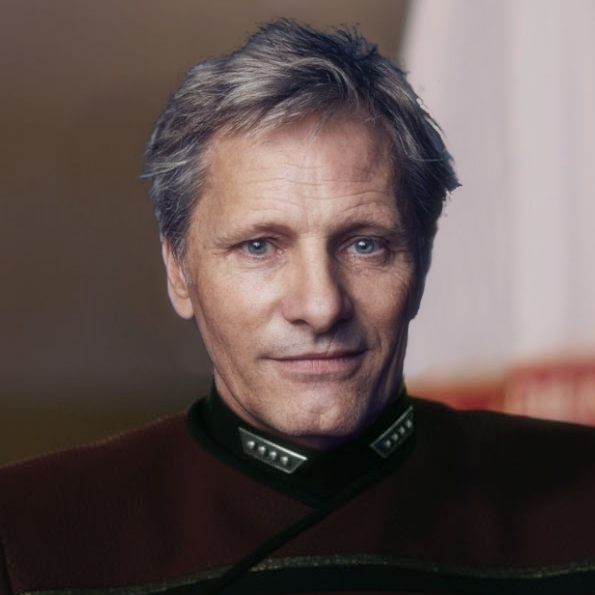







“Firefighters, huh?” Lieutenant Ollie Blackwood chuckled, standing on the bridge of the Procyon as it raced towards Anglesia V. “That’s a new one for us.” And he didn’t sound like he liked it.
“Not really,” Lieutenant J.G. Nikolai Rockov stated flatly. They spent their days firefighting, if not literally, then figuratively. There was always a fire somewhere on the frontier, and that’s where they went. That was their purpose out here.
“Well, this one sounds like it’s gonna be smokier and sootier, I guess,” Lieutenant Blackwood shrugged. “Not that I get why this is even an us thing.” Shouldn’t these sorts of matters have been handled by a local fire corps? Or been knocked out by automated systems before it even came to that? It hardly seemed to rise to a level warranting a Starfleet deployment.
“Worried it’ll singe that mop on your head?” Lieutenant J.G. Rockov asked sarcastically, no love lost between the pair. The no-nonsense tactical officer wasn’t a fan of the showboaty, all-talk 2XO, a man who seemed out of place compared to the no-bullshit, whatever-it-takes folks that lined the halls of the Polaris‘ attached Aquarius-class rapid response escort.
“Knock it off, both of you,” Commander Eidran ordered as he clutched his temples, forcing away the strong emotions he was feeling from them. “We go because we are ordered, and we do our duty when we get there. End of story.”
“Of course, sir,” Lieutenant Blackwood smiled. It wasn’t even that he really had an issue with any of this. It’s not like he’d even go down there, not with all the others aboard the Procyon that would be lining up for it. He was just a contrarian that enjoyed poking at the true believers, the ones that treated every alert like it was a final stand, the ones that tried to act in Reyes’ image.
“On final approach,” Petty Officer Priyanka Dhawan reported, cutting into the back-and-forth and pulling them all back to the moment. “Anglesia V, dead ahead, T minus thirty.”
“Not a moment too soon,” Commander Eidran said under his breath. He was going to have to do something about Rockov and Blackwood at some point. They were always tusseling, and he was rather tired of it. There were more important things for them all to worry about, like what lay dead ahead.
The commander’s remark hadn’t been caught by the others, but Lieutenant Syleth Sh’vot, the Andorian geophysicist they’d brought along from the Advanced Science, Technology and Research Activity, heard it. “A moment too soon would have been weeks ago.” His eyes stayed on his PADD, still trying to make sense of it. “Or decades. Their whole extraction operation, it’s somewhere between hubris and inevitability.”
“You think this is more than a firestorm?” Commander Eidran furled his brow. Up until now, the Betazoid had assumed they were looking at command logistics support, helping the planetary EMD get organized, but what he was feeling off the Andorian, there was something more.
“I won’t know until we get eyes on, but…” Lieutenant Sh’vot began to say.
He never got the rest out though. Not as the ship emerged from warp, the class M world of Anglesia V dead ahead. Or at least what should have been a lush, blue-green, habitable class M world.
As they stared, what the crew of the Procyon saw looked more akin to a class G volcanic rock, a planet covered completely by a giant dark gray ash field, flashes of red-orange luminance flickering across its midsection from somewhere deep below.
“Is that… am I seeing that right?” Commander Eidran fumbled, his mouth agape. He’d expected they might see a few smoke plumes from outer space, but not more. This was something else altogether. “Is… is the entire planet on fire?”
“Not exactly,” Ensign Evelyn Luna offered from the operations console. “What we are observing is a globally-encircling ash cloud fed by twenty-seven distinct fire complexes across equatorial and mid-latitudinal bands.”
“Twenty-seven?!” Commander Eidran stammered, taking in the news. When the call had first come in, there’d been nine. En route, EMD had called back to upgrade it to fourteen. Now, it had almost doubled again. Whatever was happening down there, it was accelerating. Regardless, though, that didn’t change their top priority: life safety. “Luna, map the current fire perimeters as best you can, and interpose with urban and industrial centers. Put it up when you’ve got it.”
It didn’t take her long, and a moment later, she cast a surface projection up onto the viewscreen. Along the equatorial belt lay perimeters around the original ignition points, each in proximity to an extraction operation, but the new perimeters, the ones that had just kicked up since the last report, they had migrated northward, some in undeveloped territory, and others near, or in one case fully intersecting, urban areas.
Commander Eidran’s focus drew towards a mid-latitudinal perimeter that overlapped one of the city markers. “That one. What’s going on there?”
“Hard to get specific details through the thermals and heavy smoke,” Ensign Luna explained. “But that’s definitely an suburban center, population estimate twenty thousand, heavily involved with fire.”
“Can we get a visual?” Commander Eidran requested.
“Not a chance,” Ensign Luna replied. “Too much smoke. Want me to launch a probe?”
“Do it,” Commander Eidran ordered, his mind on what the firestorm might be doing to that urban area. They needed to know. But while they waited, he stared at the map. There was something more there. Although the ignition points were scattered across thousands of kilometers, if you drew a circle around them, they seemed to have a plume-like shape. “Why is everything igniting? A planet doesn’t just spontaneously light on fire, everywhere, all at the same time.”
“Not all at the same time, but yes, in this case, it is lighting in sequence, spreading across the surface,” Lieutenant Sh’vot volunteered, a hypothesis already forming in his head.
“Go on,” Commander Eidran instructed.
“It appears we are witnessing a lithospheric integrity failure,” Lieutenant Sh’vot shared. “The deep mineral seams the Anglesians exploited to extract mantle effluent were never meant to sustain such pressure, and it looks like their operations have weakened the surrounding crust over time. What were once controlled vents are now opportunities for breakthrough… and they’ve now broken through.”
“Are you certain?” Commander Eidran asked.
“Smoke content is generally consistent with mixed wildland-urban constituents,” Lieutenant Sh’vot shared. “But if you remove those analytes from the chem panel, I’m also detecting gases consistent with mantle convection. So yes, fairly certain.”
“But why’s it happening in so many places all at once?” Commander Eidran inquired, asking the obvious next question. “Sounds like a volcanic eruption, but volcanoes don’t spread.”
“Volcanoes are point failures”, Lieutenant Sh’vot explained. “They form when localized pressure finds a stable pathway to the surface. What we’re seeing is the opposite. The artificial seams have reduced the lithosphere’s strength, and that’s what restrains the mantle’s convective energy. Without that, you get a breakthrough, which then weakens adjacent strata, lowering the threshold for the next failure. It’s a cascading collapse of the crust, not a pressure relief valve for the mantle… think of it like how a crack spreads in the ice on a frozen lake, except with the addition of planetary-scale upward pressure from the mantle’s convective motion.”
A lot of technical jargon, but Commander Eidran followed the gist. “So basically, they cracked the crust, and now the mantle is oozing out, lighting everything it touches?”
“That is my current hypothesis, yes,” Lieutenant Sh’vot nodded grimly.
“I don’t presume there’s an easy way to put it back together?” Commander Eidran asked, although the magnitude of what the astrophysicist was describing already told him the answer.
“Afraid not,” Lieutenant Sh’vot shook his head. “This is not the sort of failure you can just repair. It’s a planetary-scale process.”
“Is there any scenario where this process might self-stabilize?” Commander Eidran inquired.
“No,” Lieutenant Sh’vot replied. “This isn’t a burn that will smother itself. The crust is failing in slow motion. Left alone, the fire doesn’t stop when it runs out of trees. It stops when it consumes the planet.”
A pin drop could have been heard in the silence that followed.
But there wasn’t time to consider his words as Ensign Luna spoke up: “We’ve got visuals coming off the probe now.”
“On screen,” ordered Commander Eidran, turning back towards the viewer.
When the feed resolved, all they saw at first was a wall of gray, the image completely obscured by thick, dark gray smoke. But as the probe descended further, the city came into view.
Or, at least, what was left of a city.
As far as they could see, buildings were ablaze. Flames bent sideways, driven by convective winds, while embers cast off the burning structures raced down narrow thoroughfares like a swarm of fireflies, striking and lighting anything they touched.
The picture zoomed in on a block of homes thus far still standing. They saw residents racing out on foot under the deep black smoke. But only a moment later, something caught fire. It was hard to know exactly what had lit it, whether the heat beneath or the flaming debris flying all around, and within minutes, the entire block was consumed in flame.
“Where are the evacuation teams?” Lieutenant Blackwood asked, at a loss for words as he watched the evacuees vanish under the swirl of orange and black.
“They’re not coming,” Lieutenant J.G. Rockov noted flatly. “Monitoring tac channels. Every available resource is committed. They’re on their own.”
“No they’re not,” Commander Eidran interjected as he looked around the bridge. “Not every resource is committed just yet.” He had dozens of able-bodied officers aboard the Procyon, and there were thousands more just a short warp jump away. “Lisa, get a line to Polaris. You and Sh’vot bring them up to speed. We’re gonna need assistance, and fast.” The warning from the astrophysicist about where this was going hung heavy on his mind.
Dr. Lisa Hall nodded curtly. While she hadn’t said a word, she’d been quietly taking it all in, and what she and Dr. Sh’vot would need to recommend to Reyes already seemed self-evident.
Commander Eidran then turned to Lieutenant Blackwood. “Ollie, you and Luna are incident command. Call it as you see it from up here, and establish with planetary EMD when possible.”
“Understood,” Lieutenant Blackwood nodded, a bit relieved by the task he’d been assigned, sensing what Commander Eidran had in store for the rest.
And sure enough, Commander Eidran then turned towards his tactical officer and gave the order: “Nikolai, assemble the team. Besides logistics, medical and essential crew, we’re going down there. All of us.”