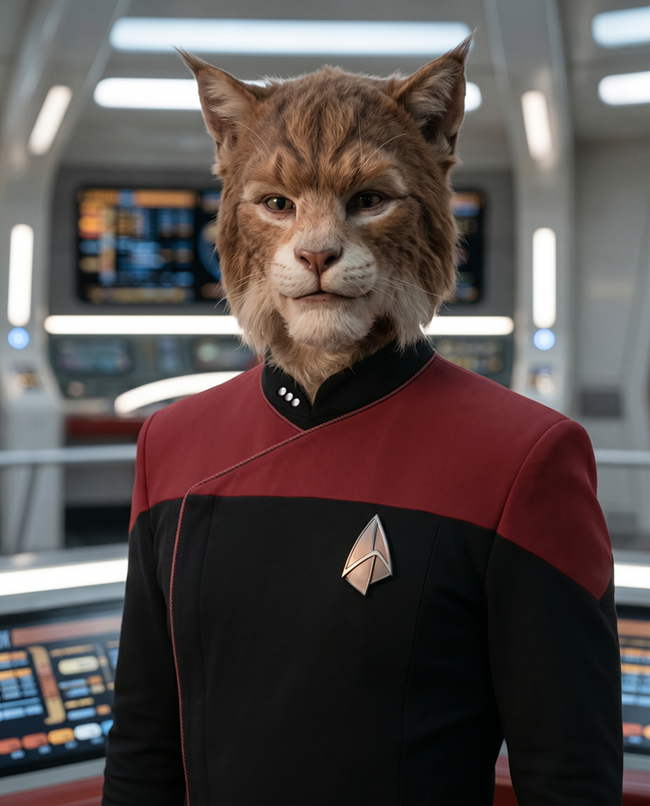







Captain’s Log, Stardate 80261.5
Three days… For three days, the Malinche has been stuck at Starbase 72, caught in endless bureaucracy. The inquiry started slowly and methodically, picking apart every action and decision, all measured against rules that feel outdated for this galaxy. In Command’s eyes, our intervention on Cygnus Prime crossed several lines. We hacked a classified Cardassian communication array to intercept True Way orders. We entered the DMZ without authorization, violating the joint-use treaty. Worst of all, we launched a covert extraction of civilians under fire, bypassing local authorities entirely. My crew is restless, their frustration almost tangible as it spreads through the ship. I see it in their eyes, the question they’re afraid to ask: was it worth it? We stopped a war, prevented mass bloodshed on both sides, but maybe we broke the very laws we promised to protect. Now, as we wait for a verdict that might never come, a new threat is growing, not from space, but from inside. The ghosts of our past are not easy to put to rest.
******
The usual sounds of the ship had changed. Instead of the steady, confident hum of a ship on a mission, a low, anxious buzz now filled the air, like a trapped animal. Every hallway and room felt smaller and more closed in. The starbase outside the window was a constant reminder that they were stuck, pampered and inspected in equal measure inside a fancy cage.
In the main astrometrics lab, the darkness felt almost solid. Commander Tarya Zeltek sat alone, lit only by the glow of a single holographic display. She was looking at the “Observer_7” file, the digital ghost they had found deep within a hidden partition on the Cygnus server during their emergency data recovery. It had been camouflaged as corrupted telemetry, discovered only when their scans picked up its anomalous encryption signature and self-replicating code. No one knew who wrote it, but it appeared in the system just hours before the station’s collapse. The file’s presence was a warning sign, proof that someone or something was inside their networks and always a step ahead.
She brought up the last paragraph again. “I see you, Malinche. I see your predictable, orderly little ship. Let’s see how you handle a little entropy.”
The words challenged everything she believed. To her, logic meant order. The universe, at its heart, was made up of laws and principles that could be understood and predicted. Chaos was just missing information. But this being, the “Architect,” didn’t just work in the gray areas; it thrived there. It saw chaos not as a lack of order, but as a tool, even a weapon.
She scrolled back to the middle of the file, to the passage that unsettled her most:
“You will look for my motive. You will build a model of me and test it against every choice I make. You will be wrong. Not because your model is flawed, but because you need me to be consistent. I am not. I am the variable you forgot to account for. The one you will call a flaw until it kills you.”
That was the part she couldn’t argue with. The author was extremely smart, deeply analytical, and totally lacking in empathy. It was the mind of a god or a devil, looking at an anthill and wondering what would happen if it kicked it.
But something else had been nagging at her, a detail she’d flagged and set aside. The file spoke in the first person, singular, always I. But the encryption signature underneath it was layered, three distinct key-generation patterns braided together like a rope. Either one author had built a deliberately schizophrenic cipher, or there was more than one hand on the pen. She’d run it twice. The result was the same both times.
For the first time, her Vulcan-Romulan background felt like a weakness. Her logic wanted a pattern, a motive, a weakness to exploit. But the Architect was pure chaos. She was starting to see that chaos couldn’t be beaten with formulas. It took faith, not in a god, but in something else. Something unpredictable. Something illogical. In people.
******
The security bay buzzed with controlled energy. Lieutenant S’rrel moved quickly through the training course, his body a blur. He had the grace of a predator, his phaser rifle moving as if it were part of him. He fired three shots, each hitting the center of the holographic target. He kept going, reloading as he moved, every motion efficient and precise.
He had been here for ten hours. He was hunting, not in the ship’s halls, but here, in the simulations. He was chasing the True Way, driven by frustration.
He finished the course, breathing hard, his fur wet with sweat. He lowered his rifle and looked around the empty room. He was alone, but it didn’t feel that way. He carried the memory of every life he had taken and every life he couldn’t save. He could almost feel the eyes of his ancestors, Caitian warriors who believed there was no greater honor than a good death in battle.
But this wasn’t an honorable death. It was a slow, painful decline, a death by bureaucracy and by a Federation that had forgotten how to fight. Anger surged in him, a strong urge to act, to lash out, to find a real target and make it pay.
He slammed his rifle into the weapons locker, the metal ringing out sharply. He leaned his head against the cool surface, eyes closed, breathing unevenly. He was a warrior, a hunter, but now he was trapped, forced to watch as his prey escaped.
The door hissed open, and he didn’t have to turn to know who it was. He could feel his brother’s presence, the familiar, comforting pressure of his concern.
“Releasing your anger, brother?” M’Rashar said, his voice a low purr. He placed a hand on S’rrel’s shoulder. “You’ve been here for ten hours.”
“The simulations are getting easier,” S’rrel growled, his eyes still closed. “I’m getting faster. More efficient.”
“You’re getting obsessed,” M’Rashar countered, his voice soft. “This isn’t a hunt, brother. It’s an obsession. And it’s eating you alive.”
S’rrel’s tail lashed with frustration as he finally turned to face his fellow Caitian. “The signal is gone, M’Rashar, but the True Way cells that Cygnus manipulated are not. They’re scattered, yes, but not defeated. Every time they’re allowed to regroup, more innocents are put at risk. What do you suppose happens when a predator pack loses its alpha? They don’t just disperse. They wait, they watch, and eventually, a new leader emerges. We’re giving them that time.”
“We are following protocol,” M’Rashar countered, his own tail twitching uneasily. “Starfleet Command has its reasons for keeping us here.”
“Protocol?” S’rrel’s voice fell to a dangerous low tone. “Protocol is what allowed this conspiracy to grow in the shadows. Protocol is what’s letting them slip away now while we’re docked at this starbase playing the good little officers. Every moment we wait, another cell establishes a new network. Every hour we debate regulations; another weapons cache moves deeper into the DMZ.” He stepped closer, his blue eyes locked with M’Rashar’s. “I didn’t join Starfleet to watch while the enemy regroups because someone in a comfortable chair on Earth decided the paperwork was more important than prevention.”
He turned back to the weapons locker, fists clenched. Anger rose in him, fueled by a past that wouldn’t let go. The Dominion was gone. The Cardassians were just a memory. But the True Way was still real. They had pulled the trigger. They had hurt the colonists. Being manipulated didn’t erase their guilt, it only gave them an excuse.
M’Rashar came up behind him, his voice like an urgent whisper. “Then don’t trust the system. Don’t trust the captain. Trust me. Trust us. We’re your crew. We’re your family. Let us help you carry this. Before it crushes you.”
S’rrel stood there for a long moment, his shoulders shaking as he tried to hold everything in. Then, slowly, he leaned his head back onto his brother’s shoulder. He didn’t say a word. He didn’t need to. In the quiet security bay, a warrior finally let himself be vulnerable.
******
Captain Sh’rra sat in her office, with only the consoles giving off any light, and the only sound was the steady beep of the display panel as she tried to distract herself by reading a data pad, but it didn’t help.
The ship’s stillness in spacedock made her uneasy. She could feel her crew’s frustration, simmering just beneath the surface. The weight of command felt like a heavy cloak she couldn’t take off.
She had made her choice. She trusted her crew, and she had been right. They did the impossible and stopped a war. But now she was paying the price, the cost of being right in a galaxy that valued order more than truth.
The door to the ready room swished open, and Commander Thane entered, his Aurelian features cast in shadow. He carried a PADD, his movements slow, deliberate.
“Joril,” Sh’rra said, her voice soft. “What is it?”
“The preliminary report from the inquiry,” he said, his voice a low baritone. “They’re… not happy.”
Sh’rra took the PADD and read the report. It listed failure after failure: violation of sovereignty, endangering a civilian asset, unauthorized use of force. It was a perfect example of bureaucratic blame.
“They want to formally reprimand the whole senior staff,” Thane said, his voice heavy. “And they’re calling for a full review of your command, Captain.”
Sh’rra looked up from the PADD and met his eyes. She saw doubt and fear there.
“And what do you think, Joril?” she asked, her voice quiet. “Do you think they’re right?”
Thane was quiet for a moment, his wings rustling. “I don’t know,” he said softly. “I know we did the right thing. But we broke the rules, a lot of them. And the rules are all we have. They’re what set us apart from the True Way and the Dominion.”
Sh’rra stood and walked to the window, turning her back to him. “The rules are just a guide, Joril. They’re not sacred. They’re like a map, and sometimes the map is wrong. Sometimes you have to trust your instincts and your crew.”
She turned to face him, and for a moment the certainty she’d worn like armor slipped. “I think that’s true,” she said, quieter now. “I think. But I’ve been wrong before, Joril. People have died for my being wrong. And I’ll carry that until the day I don’t wake up.” Then the armor came back, and her voice steadied. “I’d do it all again anyway, without hesitation. I’d make the same choice because I trust you. I trust Tarya, Jendara, Vivian, and S’rrel. I trust you all to do what’s right, even when it’s hard or frightening, even if it means breaking the rules.”
Thane didn’t answer right away. He looked down at his hands, and when he spoke, his voice was smaller than she’d ever heard it. “It’s not the reprimand that frightens me, Captain. It’s that they might be right about me. That I signed off on every one of those calls because you were certain and I wasn’t. That if you’d been wrong, I’d have followed you anyway, and I wouldn’t have known the difference until it was too late.” He finally met her eyes. “What if my judgment isn’t worth anything on its own?”
Sh’rra let the question sit. She didn’t rush to reassure him. “Then the next time you think I’m wrong,” she said, “say so. Loudly. In front of the crew. That’s the only way either of us finds out.”
Something in his posture changed. The fear didn’t vanish, but it settled, finding a place to stand. His confidence returned, not as something fragile, but as something solid and steady.
“You’re right, Captain,” he said, his voice firm, his shoulders straightening. “We’re the only ones who know.”
Sh’rra smiled, slowly and genuinely. “Then let’s get ready to fight.”
As he left, she turned back to the PADD. She knew the inquiry would be long and difficult. She knew they would face blame, criticism, maybe even a court-martial. But she also knew it didn’t matter. War was coming, and everything was at stake: galactic stability, the safety of uncountable civilian lives, and the future of the Federation itself. If they failed, all of it could unravel. She and her crew would be ready.
On the console beside her, a status readout flickered. Just once. A single amber blip in a field of green, there and gone before she could focus on it. She frowned, made a mental note to have Engineering look at it, and turned back to the PADD.
Then the ship lurched violently, making her stumble. The lights flickered and then went out, leaving the room in sudden, frightening darkness. The steady engine hum was gone, replaced by complete silence.
“Report!” she yelled, tapping her comm badge as her voice cut through the sudden chaos.
“Captain!” M’Rashar’s voice came over the comm, rigid with panic. “We have a massive system failure! Across the board! Life support is failing on Decks 7 through 12, and Engineering is reporting system-wide failures.”
Sh’rra was already moving. “What’s the cascade pattern? Where did it start?”
A pause. When M’Rashar answered, his voice had a new edge to it, the sound of a man staring at readings that refused to make sense. “That’s the thing, Captain. There isn’t one. Engineering says the failures aren’t cascading at all. Deck 7, then Deck 11, then Deck 8. No sequence. No shared junction. No cause they can find.” Another pause. “It’s like the ship is failing at random.”
Sh’rra felt a chill run through her. Not sabotage. Not a bomb. Entropy. This wasn’t just a random malfunction, it was an attack. Silent and unseen. And somehow, she knew, even if it made no sense, that the Architects had finally made their move.