






“There is a homely old adage which runs: “Speak softly and carry a big stick; you will go far.”
Theodore Roosevelt. (1901)
As it had been since the time of the Roman Empire, the doctrine of Force Projection had been employed in international relations, seeking to deploy and sustain forces outside of its own territory, to serve as an effective diplomatic level intervention capable of influencing the decision – making processes and acting as a potential deterrent on other state’s behaviors.
In the 25th century, whilst committed to the ideals for peace and egality, the United Federation of Planets had itself found itself reeling from a series of disastrous setbacks, from the destruction of the Utopia Planitia shipyards on Mars, through the devastating events of Frontier Day and culminating with the widespread damage of the Vaadwaur Invasion that had degraded its fleet dispositions and weakened its cachet amongst the galaxies’ involved species.
Whilst it’s Starfleet had rallied around it what allies it could find in such desultuerous times and had marshalled its not-inconsiderable remaining industrial resources to focus on rebuilding the diminished naval – assets lost in those conflicts, replacing in their stead a new generation of craft with which to carry on the defense of UFP territory and rekindle their original mission of exploration and diplomacy, the one thing that was not so easily replaced was its people.
A whole generation of Starfleet’s best and brightest had been wiped out during the Borg incursion suffered as the Federation had gathered its fleet together to commemorate. the anniversary of the Enterprise NX-01’s maiden voyage in April 2151 AD. In 2401 Starfleet lost a whole generation of officers under the age of 25 and it would be many years until the Starfleet Academy was ready to graduate their successors.
In their stead, those gaps in manpower had been backfilled by assigning command roles to much more junior officers, meaning the promotion track itself had been fast tracked and now the people that presided over some commands lacked the seasoning that only comes with practical experience. In some cases, veteran senior officers had been coaxed back out of retirement and again the experiential gap between age and youth still persisted.
Hence, despite the misgivings of some of the more moderate voices in Starfleet Command, the Dreadnought – class starships had been taken out of the mothball fleet and pressed back into service. Ostensibly fielded to remind the Galaxy that the United Federation of Planets may be down and its nose be metaphorically bloodied by the series of misfortunes it had suffered, but it was most certainly not out for the count.
In this role they were undeniably effective. A more blatant instrument with which to project power and reinforce that key message could hardly have been imagined. An up gunned evolution of the venerable Galaxy – class, the Dreadnought – class was certainly a very big lever.
There were some opponents of the deployment that preferred to see these venerable old – war horses deployed only on missions of ‘soft – power’, securing the galaxywide subspace communications network, performing missions of humanitarian aid and evacuation and providing the well- founded cornerstone to peacekeeping operations.
The more hawkish of their colleagues argued that the Dreadnoughts were wasted on such run – of – the mill deployments and should be held in reserve to carry out missions requiring ‘hard – power’, show-the-flag cruises, compellance/deterrence operations and (when there was no other option) to judiciously prosecute armed interventions for the security of the Federation and her allies.
The stark reality of contemporary galactic affairs and the fractious state of inter – species politics meant that, whilst both doctrines were theoretically possible, thankfully the altruism of the Federation meant that cooperation was still valued above conflict and the Dreadnoughts were more often deployed on missions of the latter, more benevolent nature.
Yet the uncertainty of modern times meant that the original Dreadnought – class Heavy Explorers, being some 30 years old by the current Stardate and built only in small numbers to answer the original historical threats of the Borg and Dominion, were beginning to show their age and could not possibly be deployed in the numbers Starfleet required.
Thus the Lexington – class had been born. A subclass developed from the Yorktown – class Heavy Explorer, themselves a natural developmental evolution of the capable Odyssey – class, the Lexington’s represented the newest generation of bleeding – edge technology that could fulfil the multi – modal mission profile of her sister – ships, whilst wielding a very big stick indeed, in terms of martial capability and force projection.
Which is why the namesake, lead – vessel of this class, the USS Lexington, was currently making way at full warp towards the Beta Quadrant, there to fulfill a request by the Federation’s allies in the Romulan Republic by conducting a show-the-flag cruise within the Ecrus System, specially the volume of space that contained the fantastically lucrative gas – giant planet, known as the Tsangaris Massif.
Since the destruction of the Romulan Homeworld, the evacuation of her people became the symbolic death nell for the Romulan Star Empire and heralded its collapse into division and acrimony as her once – proud people were reduced to a series of disparate and bickering fractured factions of balkanized – refugees.
Of the two organizations that struggled out of the ashes of their demise, the Federation judged that the Romulan Republic represented the more democratic polity, when compared to the more militaristic Romulan Free – States who preferred to cling to the more extreme and subversive world – view of the former Empire, and it was to these moderates that they made peace with and allied to their cause.
The civil war between both inheritors of that dubious estate seemed without end and the Free States perpetually strove to wrest from their former countryman any advantage or hopes for stability by means both overt and (as was traditional with the Tal Shiar that their regime retained) covert.
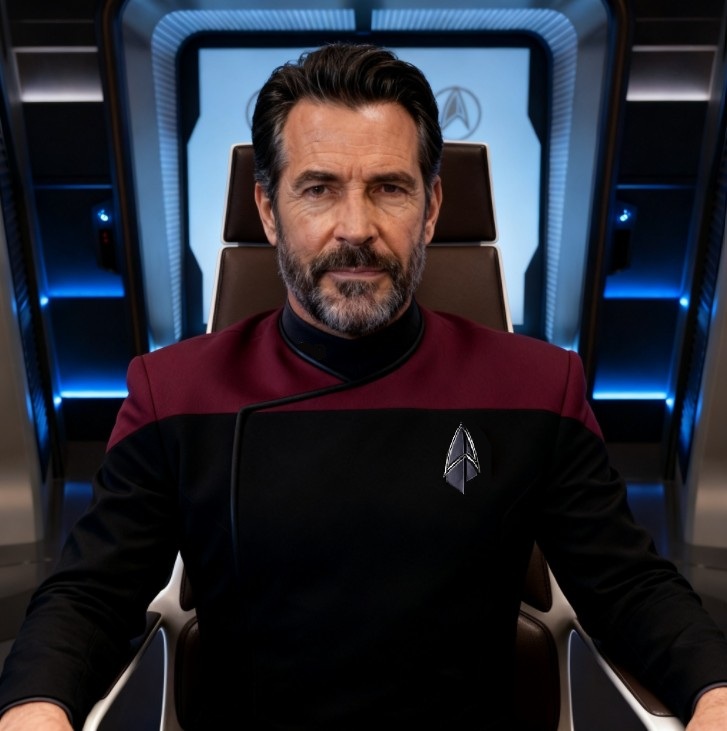
So it was that Fleet Captain John Kingsman and the crew of this considerably capable Starfleet Asset had been tasked to assist its allies in the Republic by asserting their presence into the Ecrus System, where the local government were struggling with an insurgency from Separatist forces that were almost certainly being agitated and shadow – funded by the Romulan Free States from the off – stage wings of this Machiavellian production.
The master of this mighty vessel with its legendary name rarely sat the famed ‘Captain’s Chair’ on the bridge of his starship, mostly leaving the day – to – day business of running of the ship to his more – than – capable First Officer, Captain Samantha Hyland.
More typically Fleet Captain Kingsman found himself inhabiting the ‘Command Bridge’, the second command and control space that would assume control of the main hull and its powerful spinal – mounted phaser – cannon when the ship was separated in MVAM mode and in standard use acted as the ships Command & Communication (C&C) facility.
Assuming the role that would be relinquished to a Starfleet Flag officer, when embarked aboard, the Fleet Captain utilized this space to maintain a wider sphere of influence over the distributed operations of the Lexington, her embarked and deployed sub – vessels and fleet coordination of any assets temporarily assigned under her command.
In many ways a carbon – copy of the Main Bridge, the Command Bridge nevertheless maintained a far greater focus on information gathering, data interpretation and complex communications traffic, that did her more traditional counterpart.
This space was routinely staffed by personnel that answered to the Lexington’s Chief Strategic Operations Officer, who was responsible for coordinating and advising the CO on all matters of strategy, fleet liaison and operational execution within the ship’s sphere of influence.
Aboard the USS Lexington, this focal role was fulfilled by the Efrosian, Commander Fy’Valla, whom John Kingsman had served with for some years now and had come to trust the white – haired, orange – skinned woman’s guile and judgement maybe second only to his own.
Fy’Valla was supported in turn by the scarily – capable Lieutenant – Commander Savak.
As the most senior Starfleet Intelligence officer assigned to the ship, it was Savak’s duty to gather, analyze and interpret threat information gathered from intercepted signals intelligence (SIGINT), Measurement and Signature Intelligence (MASINT) provided by the Science Department, open – space intelligence (OSINT) gathered from publicly available sources and finally Human Intelligence (HUMIT) gathered directly through interviews, informants and espionage carried out through agents in the field; and then disseminate that information to the Chief Strategic Operations Officer.
That Savak was a hybrid of both Vulcan and Romulan parentage, made the young woman undeniably effective in this role.
Reflecting perhaps the Fleet Captain’s personal preference and most certainly Starfleet’s predisposition towards diversity, the final corner of the triumvirate that inhabited the C&C and advised Kingsman was completed by Lieutenant-Commander Krela, the Chief Flight Control Officer.
One of only a handful of Kazon to have graduated the Academy and certainly currently the most senior of his Delta – quadrant species serving on active duty with Starfleet Krela, with the traditional matted cornucopia of dreadlocks that identified him as a member of the Kazon – Mostral, looked slightly uncomfortable in the neatness of his Starfleet – issue uniform, yet was a highly capable warrior and himself a fearless pilot worthy of his nomadic – people.
Onboard the Lexington, the Lieutenant – Commander acted in the capacity of the Commander of the Air Group (or CAG), ultimately responsible for the management and deployment of the vessels two embarked starfighter squadrons, the VA-237 ‘Banshees’ & the VA-226 ‘Buccaneers’, in addition to the wide range of runabouts, shuttlecraft and worker bees that swarmed the Dreadnought’s surrounding operating – envelope and beyond.
As the great ship made its way towards its destination, Commander Fy’Valla was delivering a briefing to the CO on the current situation in the Ecrus System, represented there in the large holographic situation board, that predominated the rearward portion of the Command Bridge.
“Our allies in the Romulan Republic have been engaged in Gas mining and extractive industries throughout the Ecrus System, since early 2389.” The Commander noted, as the gently – glowing holograms reacted to her slim, orange fingers as they played through the representations of data and production installations on the board. A sub-menu opening as she pinched and released her digits, blossoming open to present an array of salient datasets that scrolled and informed.
“The industrial output of the various refinery and processing concerns within the volume account for nearly 23 percent of the Gross Domestic Product of the Republic, so it is safe to say that the region itself represents a key economic and strategic hub for the Romulans.
John Kingsman said nothing but nodded. Taking a sip from the mug of coffee that his holographic – valet, Benson, had brought him. The urbane Commanding Officer of the Lexington’s eyes were intent, focusing on every detail as his command staff relayed their brief.
Commander Fy’Valla hands swiped across the table and the effect was to zoom and condense the data display to focus on a particularly large blue/purple orb.
“Chief of those assets and focal to the entire economic framework in the system is the Gas – Giant of the Tsangaris Massif.” The Strat Ops officer explained as the great pearl of swirling cloud grew in magnification until it dominated the air between the senior officers standing around the table.
“Mining operations centered around the Tsangaris Massif provides the Romulan Republic a range of exotic and rare gaseous elements including helium, ammonia, anhydrous methane and both molecular and metallic hydrogen, the latter of which is a key industrial component in the founding and annealing process for raw deuterium used for the construction of starship internal structural members and outer – hull plating. The Federation and Starfleet are one of their biggest customers.”
John could see then, why the USS Lexington had been dispatched by Starfleet Command to establish a presence in this region of space. The need to project soft – power and reassure her allies of its commitment to their security and shared economic benefits was the perfect application of the symbolism that this legendary ship embodied.
He pointed to several long, roughly rectangular objects that circled the orb and occasionally sank into or rose from its great surface of cloud. The holo – display was linked to active telemetry being transmitted from the system, so the simulated movements they saw here were being mirrored in the real – world by their physical counterparts.
“What are these objects here?” Captain Kingsman enquired, they put him in mind of the ponderous cetacean whales that assisted Starfleet in the study of Advanced Astrometric and Stellar Cartography.
Fy’Valla nodded and, reaching over into the hologram, seemed to grab one of the tiny representations with her fingers and physically lift it out of the display, as if she was grabbing a fleeting goldfish from some ornamental pond.
The tiny glowing icon remained in her hand, until the Efrosian woman flicked her wrist – throwing the hologram up into the air, where it too appeared to zoom in size and detail until it hung between them, looking like the curious fusion of maybe a leaf – blower crossed with a shark.
“This is one of the Sky – Rigs.” The Commander explained as the mammoth craft began to slowly revolve around it’s horizontal access, like a kilometer’s long car on the turntable of some impossibly exotic car – expo. John half expected a beaming model to be leaning upon it, drumming her fingernails against its vast flanks. He smiled at the mental image, then dismissed it and resumed focus as Fy’Valla carried on.
“A proprietorial technology, the ‘Sky – Rig’ is a fully autonomous gas – extraction & processing platform, capable of fully independent round-the-clock operations and engineered to survive the hostile temperature gradients, magnetic storms, crushing atmospheric pressure differentials and extreme gravity encountered at the kind of depths it operates in, within the Gas – Giant. Typically, they range up to about 40 kilometers from prow to stern and displace roughly 400,000 to 500,000 Gigatons unladen.”
“Basically, a flying refinery?” John sipped his coffee again, impressed by the scale of ambition it must take to create such a thing.
Fy’Valla nodded.
“Just so. Able to ingest, separate and refine millions of tonnes of exotic elements an hour, when their storage tanks are filled, each unit automatically returns to the upper regions to offload its cargo to waiting orbital tenders, before descending to commence a new cycle.”
She ‘threw’ the Sky – Rig back into the hologram, where it twisted and shrank back to its original size and commenced to sink slowly back into the representation of the Massif, slipping back into the crushing depths to drink its fill.
“Each one costs about the same amount of at least three of our Typhoon – class Exploratory Cruisers to produce and their net production output capacity represents somewhere in the region of 69% of the systems overall fiscal returns.”
John Kingsman nodded, coming to the real reason behind their mission.
“And one of these monsters is missing?” The Fleet Captain asked rhetorically.
Lieutenant-Commander Savak stepped forward, every movement considered and no action wasted as she took up the baton and assumed the narrative of the briefing.
“Contact was lost with the unit designated “Rig#19” nearly 4 weeks ago.” The intelligence officer reported evenly. That strange mélange of steady Vulcan logic and carefully calculating Romulan guile always served to make Kingsman feel slightly on edge around the woman, she could be quite disconcerting at times.
“4 weeks?”’ John frowned, “For an asset as invaluable as it purportedly is, isn’t that rather a long time to pass before the Romulan’s realized one of their toys was missing?” The CO challenged skeptically.
Savak looked unconcerned.
“Not particularly. Romulan psyche is predominated with the social imperative of ‘Saving Face’. In the former Star Empire, any admission of failure was seen as a weakness and weakness was an intolerable transgression that would be ruthlessly excised by the Tal Shiar.” The Starfleet Intelligence officer shrugged lightly.
“Old habits die hard and it is more than likely that the System Governor tried to hide the loss of the Rig from his superiors and probably attempted several recovery operations of their own, before having to concede defeat and reach out to the Federation for assistance. To do so would mean a considerable loss of cachet in the eyes of the Republic.”
Kingsman nodded thoughtfully.
“So, we are dealing with a delicate situation where the proponents are more than likely already very oversensitive to the current state of events. That’s good intel Lieutenant – Commander, we will be careful to tread lightly in our negotiations and dealings with the local government.” John reasoned.
Savak nodded her head in appreciation of his praise and then Captain Kingsman asked;
“What information do we have around the set of circumstance that lead to the Romulan’s loss of communication with the rig?”
Savak’s expression did not alter by as much as a micron, as she replied.
“Whilst some form of technical failure is not impossible, neither is it thought likely, the rigs themselves have triple – redundancy on most systems and are controlled by a semi – aware AI core that regulates all functions and operations. If there was a critical failure, all Rigs are programmed to return to the surface, whereas Rig#19 has descended to just on the redline of what is considered its ‘crush – depth.”
“Telemetry suggests it is still operational, but there is no way of verifying this as there is no vessel capable of descending to such depths without risking total structural collapse, the Lexington included. The current hypothesis of the local authorities leans towards an act of sabotage.”
“Sabotage?” Kingsman rolled the thought around for a while. “But by who? And how? I thought you said that the Rigs were fully autonomous? Do they carry any crew?”
Savak waited for his questions to subside, with the air of a patient yet slightly aggrieved school – ma’am. When she saw her opening, she explained.
“As a final layer of redundancy, each Sky-Rig carries aboard a single, organic crewman who acts in a ‘caretaker’ role, whose only function is to ensure that a Rig returns to the surface in the event of an emergency where the AI processing core would suffer a catastrophic failure.”
“Whilst these caretakers are extensively vetted, it is not inconceivable that the individual aboard Rig#19 may conceivably be a member of, or has been turned by the Reman Separatist Movement. After all, telemetry shows the Rig’s AI to still be functional, but unresponsive. This could be an intentional act.”
Captain Kingsman was concerned by this hypothesis.
“What do we know about these Separatists?”
Savak manipulated the data and the view of the Tsangaris Massif melted away and was replaced with the hard – eyed, grim grey – faced mugshot of a Reman Male in his late middle ages.
“Formed in 2396, the Reman Separatist Movement (or RSM) was originally born as a protest movement formed from dissolute and disaffected members of the Reman labor union in the system. The increasing levels of sophistication in the automation of progressively more of the extractive industrial complex in the system saw their roles retrenched and left thousands of Reman workers without a viable means of support.” Savak explained.
“Over time, as the situation worsened, they began to take on a more political slant and their leader here, Ramek, began to call for re-unification with the forces of the Romulan Free States, arguing that their lot was better when they toiled as near-slaves and soldiers under the former Star Empire and they began to style themselves as a Separatist movement and things invariably turned violent when the Republic attempted to put down their uprisings.”
“Graduating to ‘Terrorists’.” Commander Fy’Valla guessed correctly.
“Indeed.”’ Savak intoned seriously. “The actions of the RSM have become increasingly destructive and display a level of recent sophistication, that suggests that they may be receiving training and arms covertly supplied by the Tal Shiar to further destabilize the economic base of the Republic.”
“Three months ago, the RSM managed to destroy both a Sky Rig and Orbital tender during offloading operations above the Massif, so there is a precedent that does not entirely preclude their likely involvement in the current crises.”
Fleet Captain Kingsman internally summed up what he had just learned about the political situation he was about to commit his ship and crew into. There were complexities and hidden actors at play in the Ecrus System and beneath the swirling surface of the Tsangaris Massif, more intrigues lay than were apparent to first glance.
Extreme caution would have to be exercised as the crew of the USS Lexington, inserted herself into this powder – keg situation and began to assert the Federations Will.
As if bidden by his thoughts, John received a personal hail from the Main Bridge and tapped his Commbadge to open a channel.
=^= “Bridge to the Captain. We are about to drop out of warp at the edge of the Ecrus System.” =^-=, came the cool tones of Captain Samantha Hyland. =^= “I thought you’d like to be informed.” =^=
John returned the hail, please at his Executive Officers good judgement.
“Very good, Number one. I’m on my way. Kingsman out.”
He turned to both Fy’Valla and Savak and nodded politely.
“Commanders. Thank you both for your briefings. We seem to be facing a delicate situation indeed and shall continue to rely upon your diligence and advice. Please carry on.”
John took his leave and made his way to the turbolifts that would take him up to the Main Bridge, where he would most likely be leading his people unto the shores of uncertainty and perils unknown, once again.
But, at the end of the day, wasn’t that exactly what the USS Lexington had been built for?