








The chase ended in Cargo Bay 3. The air reeked of scorched plating and from discharged energy weapons—acrid and sharp. For twenty-seven minutes, Shaxea and her team sprinted after the intruder, weaving through the ship’s maintenance arteries. Shaxea signaled her team to fan out at each junction, but the intruder was not just fast—it seemed prescient, anticipating every hatch, blind spot, and ambush as if reading their intentions. Now, finally, it was cornered. The creature in Lieutenant Joric’s form stood motionless, unsettlingly serene amid the chaos.
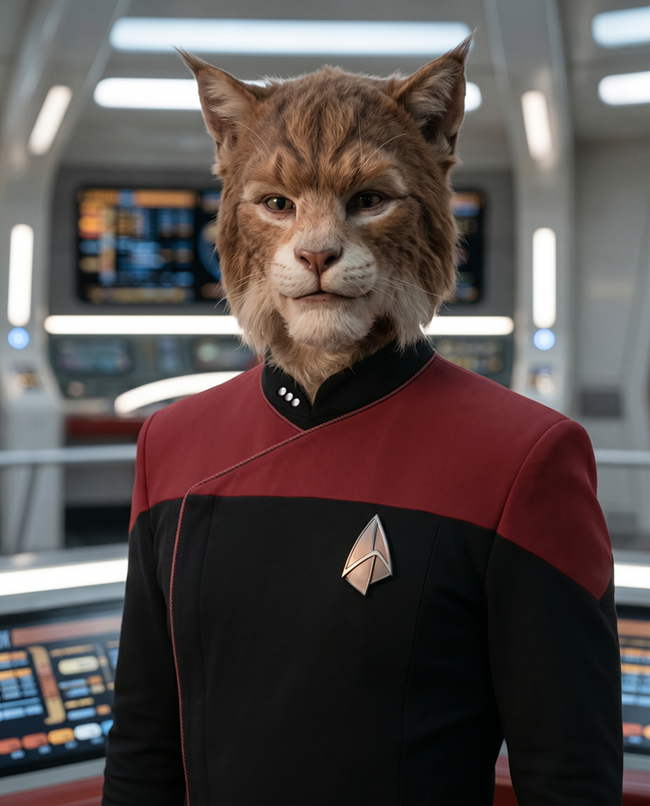
“Force field at maximum!” S’rrel snarled, his voice a guttural rasp as he punched the control panel. The Caitian’s fur bristled, tail lashing in sharp, agitated jerks. A shimmering curtain of bluish energy sprang to life, trapping the intruder. The figure didn’t flinch or raise its hands, simply standing there, observing them with unnerving calm—more terrifying than any aggression.
At the command console near the door, Lieutenant Shaxea rapidly entered commands, eyes locked on the screen. “The field is stable. It cannot dematerialize through it,” she confirmed, analyzing the containment status.
“Good,” S’rrel growled. He kept his phaser rifle firmly pointed at the intruder and began circling the containment field, his movements tense and deliberate. “Because I am done running.”
The intruder tilted its head, its expression shifting. For a moment, the face of the Joric dissolved. A smooth, featureless visage of polished white appeared, then resolved back. The impression was almost artificial—a mask sculpted after countless observations, yet devoid of identity beneath the surface. In that instant, an array of faint, shifting glyphs flickered beneath the blank skin—symbols from no living language, as if caught between worlds and purposes. The voice that emerged was not Joric’s. It was a chorus, a perfect, synthesized harmony that resonated directly in their minds. It bypassed the air and the comms.
“Your resistance is inefficient. Your struggle is illogical.”
S’rrel stopped pacing. His ears pinned to his skull. The voice was a lullaby, a melody that was soothing and promised an end to all strife. A sudden, fierce urge welled up to lower his weapon, to let tension seep from his body. It was primal: the instinct of a creature scarred by pain, longing for pack solace, pride, and safety. He quashed it. His claws slipped from their sheaths.
“Accept the order of The Shepherd,” the harmony continued, its tone gentle, reasonable. “All conflict is error. All pain is a miscalculation. We offer you the perfection of peace. We offer you the end of want.”
Then, the vision struck him. It wasn’t an illusion projected into the air; it unfolded within his consciousness, a memory not his own. Fear surged up, visceral and cold, as if some vital part of him were being tugged away. He saw Caitia, not as he remembered it, but as a realm of unnatural tranquility. The vast hunting plains had become gardens. His people sat in mute contemplation. Their predatory instincts weren’t subdued, but erased. Absent. There was no challenge. No struggle. No triumph in the hunt. Only being. He searched his own face for a sign of resistance, but found none. He saw himself, older, on a porch. His family gathered around him. They smiled, but their eyes were hollow, tranquil pools. No fire lingered. No flicker of defiance or joy. Panic twisted in his gut as sharply as grief. The familiar ache of loss bled into anger—a roaring, helpless rage at this mockery of peace. It was the stillness of a graveyard, the hush of the broken. A world without tooth or claw. A world without soul.
A deep, guttural hiss escaped S’rrel’s lips. The vision was anathema to his core. It profaned everything his family revered. His father, a diplomat, taught him that peace arose from strength and understanding, never from the surrender of self. His mother, a biologist, showed him that life was a ceaseless, fierce, wondrous struggle. This was not life. It was oblivion.
“Nooo,” S’rrel snarled, the word tearing from his throat. He took a step forward, pressing his hand against the searing heat of the force field. “My struggle is my own. My pain is my teacher. My will is my honor!”
In that moment of defiant will, something shifted. The Phantom, for the first time, hesitated. Its composure cracked. The harmony they had forged in their minds wavered. One jarring note broke its perfect chord. It processed an anomaly it could not quantify: the illogical, inefficient, and unwavering refusal of a sentient being to accept a paradise that required surrendering its own essence.
Hearing the Phantom falter, S’rrel snapped into action. “Commander, now!” he bellowed, signaling the next phase of their plan and keeping his gaze locked on the shifting figure.
From the bridge, Gordon immediately responded. “Diverting all auxiliary power to the containment emitters. Overloading the field on your mark, Lieutenant,” he said into the comm, his hands already moving over the controls.
The Phantom’s featureless face turned toward S’rrel, its placid mask finally cracking to reveal something akin to confusion. “Error. Inefficient. Recalculating…”
“Mark!” S’rrel shouted.
The blueish field flared. It turned a violent, blinding white. The Phantom didn’t scream. It simply dissolved. Its form broke apart into a million shimmering motes of light, like a dandelion head in a hurricane. The particles hung in the air for a moment before winking out of existence, leaving behind only the faint scent of ozone. There was only the deafening silence of victory.
S’rrel slumped against a console. His breath rasped in his throat. He had faced down a god and spat in its face. He had won. But as the adrenaline ebbed, an icy dread settled in. He realized the price of this battle had not yet been paid.
“Bridge to Shaxea,” the comm system chirped, the voice of the young ensign at the ops station tight with barely suppressed panic.
“Shaxea here,” she replied, her voice steady as she ran diagnostics on the overloaded emitters.
“Sir, I… I think you need to get to Commander Chen’s quarters. Her life signs just… vanished.”
The cold knot in S’rrel’s gut crystallized to ice. Chen. The brilliant, relentless science officer who had worked seventy-two hours straight, sustained by raktajino and raw intellect, to perfect the algorithm that tracked the Phantom’s signature. She had gotten too close. She had seen the face of God. God had looked back, and now it seemed as if something had reached out and unraveled her from existence itself. In his mind lingered the memory of the Phantom’s strange offer: the perfection of peace, the erasure of pain. Had Chen been claimed by that offer, her individuality dissolved and scattered across some unknowable frontier? Or was she simply gone, reduced to a hole in reality where she had once stood? The uncertainty gnawed at him, making her absence even more unbearable.
Shaxea snapped into motion, striding quickly down the corridor. S’rrel followed closely behind, not saying a word but scanning every intersection for threats. They reached Chen’s quarters as described. The door stood open. Inside, the room was tidy; a half-empty cup of raktajino and a data padd displaying algorithm equations sat on the desk. But there was no trace of Chen. Her uniform and personal belongings were gone, as though she had simply never existed.
Shaxea tapped her combadge. “Shaxea to sickbay. Report on Commander Chen.”
There was a pause. “Sir, there’s no one here by that name. I… I don’t have any record of a Commander Chen assigned to the Vallejo.”
S’rrel’s stomach plummeted. He looked at Shaxea. For the first time, he saw a glimmer in the Bajoran’s eyes that wasn’t hers. It was a horror. The Loom hadn’t merely killed her. They’d unmade her, erased her from the ship’s history, from its memory, leaving a void in the universe shaped exactly like her.
The victory in the cargo bay felt like ash in S’rrel’s mouth. They had defeated the messenger. The silent, erasing God it served had claimed its prize. The cost of knowledge, he realized, was not just paid by the seeker, but by everyone they had ever known.



A fine display of the erasure indeed! Well done. I liked hearing about S’rrel’s parents, it lent depth to him, grounded him.