








The transition from warp to impulse caused a subtle shudder. A collective exhale escaped the Vallejo as it slipped back into sublight speed. On the viewscreen, the Ajilon system resolved into a placid portrait of celestial order. A warm, yellow F-type star lit up its orbital family. Ajilon Prime, the fourth planet, appeared as a swirl of brilliant blue and vibrant green, marbled with wisps of white cloud.
Captain Harrington stood at the front of the bridge, her hands clasped behind her back, her gaze fixed on the planet below. “Report.”
“Sensors are coming online now, Captain.” Commander Gordon’s voice was the calm center of the bridge’s focused activity. “Atmosphere is 78% nitrogen, 21% oxygen, with trace elements well within Human tolerances. No signs of industrial pollutants. The planet is pristine.”
“Pristine and tense.” Harrington traced her eyes over the energy grid dotting the main continent. “Life signs?”
“Approximately 14,000 colonists clustered in three primary settlements.” Gordon’s voice was steady. “Power readings match an agrarian society supplemented by 24th-century Federation technology—geothermal and solar arrays are present. Everything appears normal.”
“Normal doesn’t produce a Priority One transmission, Commander.” Harrington’s words were soft, but her gaze was unyielding. She turned from the screen. “Hail, Administrator Hendricks. Let’s see if ‘normal’ extends to the local governance.”
A moment later, a man in his late fifties appeared on the viewscreen. His thinning hair and etched face showed a weariness beyond sleep deprivation. He wore the simple, practical clothes of a colonial administrator. But his eyes held the haunted look of a soldier who had seen a battle he couldn’t comprehend.
“Administrator Hendricks, I’m Captain Bernadette Harrington of the starship Vallejo. We’re responding to your situation.”
“Captain, thank the stars you’re here.” Hendricks’s voice was a strained whisper. “We’re… we’re holding. But I don’t know for how much longer. The situation is… unsettling.”
“We’re prepared to beam down, Administrator. My team and I.” Harrington’s voice carried a steely edge. “We’ll need a secure location to meet the individual.”
“Of course.” Hendricks nodded eagerly. “The main science outpost. It’s the most secure facility we have. I’ve cleared it out. We’re ready for you.”
“Understood. We’ll be down in ten minutes. Vallejo out.”
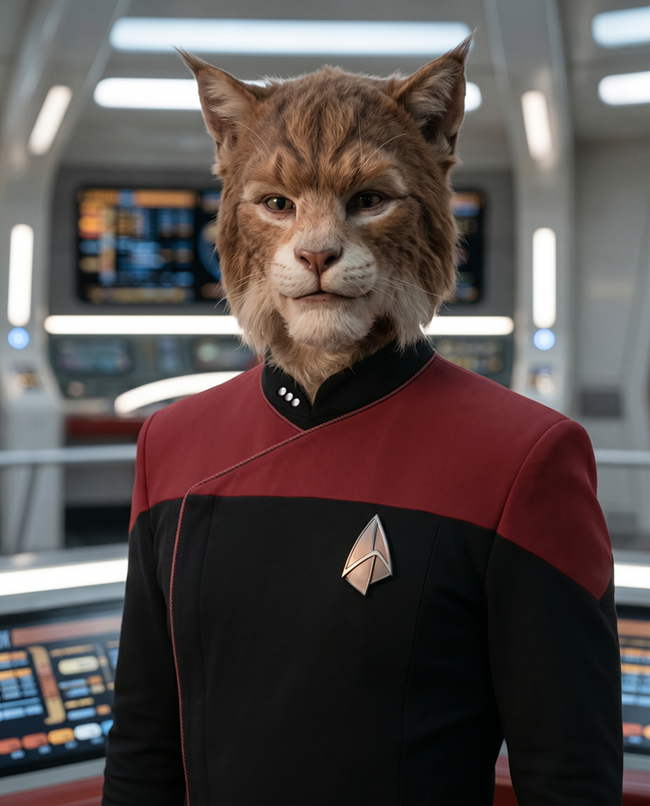
Harrington turned to her staff. Shaxea stood ready, her hand resting near her phaser at her hip, an ingrained habit, not aggressive. Lieutenant Dehner gave a slight nod, her compassionate yet piercing gaze already preparing for the psychological labyrinth ahead. Commander Gordon stood nearby, his face set in customary impassivity.
“Alright, people,” Harrington said, her tone shifting from command to camaraderie. “Let’s go meet a ghost. Shaxea, your team has the perimeter. No one gets in or out of that science facility without our say-so. Dehner, you’re on point for the initial contact. I want you to read, not just about him, but about the whole situation. Gordon, you’re with me. Let’s find out what we’re really dealing with. Transporter room in five.”
——Ajilon Prime——
The materialization process was a familiar cascade of light and sensation. Yet it always felt like a violation of the natural order. One moment, they were on the Vallejo. Next, they stood on Ajilon’s soil. The air was clean and thick with the scent of rich earth and alien flora. The science outpost was a low, modular building. Its sterile design contrasted with the lush, untamed wilderness on all sides.
Administrator Hendricks waited for them, flanked by two nervous-looking colonists armed with plasma rifles. He extended a hand slick with sweat. “Captain, thank you for coming. I… I don’t know what to say.”
“Just show us to him, Administrator.” Harrington’s tone was gentle but firm.
“This way.” Hendricks gestured, leading them through the pristine outpost corridors. The building was silent now; the staff had been evacuated. Their footsteps echoed on the polished floors, the only sound in the unnerving quiet. “He hasn’t caused any trouble,” Hendricks said, voice shaky, almost as if convincing himself. “He’s been calm. He just sits in the lab. He asked for tea, and we gave him some. What do you do with a man who appears out of nowhere and asks for tea?”
They arrived at the main laboratory. It was a large, circular room, filled with scientific equipment that now sat dormant. In the center of the room, at a simple metal table, sat the man.
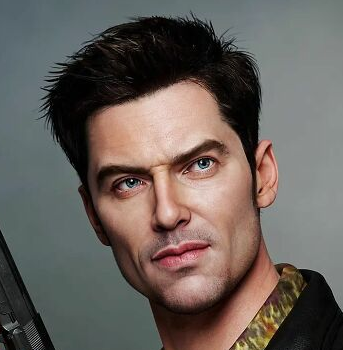
He was, without a doubt, J.P. Hansen. He had the same high forehead, noble features, and subtle eyes that had stared down the Borg. Dressed in a simple grey jumpsuit, he sipped from a ceramic mug. As they entered, he looked up. A flicker of something, recognition? Surprise? crossed his face, then faded into profound, ancient sadness.
“Captain Harrington.” His voice was the same resonant baritone Harrington recalled from history recordings. “I am… relieved to see you.”
Harrington felt a chill that had nothing to do with the outpost’s environmental controls. He knew her name. “I am Captain Bernadette Harrington of the Federation starship Vallejo,” she said formally. “And you are?”
The man set down his mug. “That is the question, isn’t it? In this reality, I am an anomaly. A ghost. In mine… I was a historian. My name is James P. Hansen. Once, I was renowned for chronicling the greatest turning points of Federation history…a trusted voice who built bridges between divided worlds. My work helped inspire the unity that defined my era. And now, I am the last man from a universe that no longer exists.”
The statement hung in the air, a declaration so monumental that it defied comprehension. Gordon raised a skeptical eyebrow. Shaxea’s hand tightened on her phaser. Dehner took a step forward, her empathic senses reaching out.
“A universe that no longer exists?” Gordon’s voice emerged as a dry rasp. “That is a significant claim. The energy required to erase an entire reality would be on a scale that is theoretically incalculable.”
“Indeed, Commander,” the man who called himself Hansen replied, his gaze meeting Gordon’s. “Theoretical. But I was there. I watched it happen.”
“Perhaps you could start from the beginning,” Harrington suggested, gesturing to a chair. “Tell us everything.”
And so, he began.
He spoke of a reality that was similar to their own, up to a point in the early 25th century. A Federation that had triumphed over its enemies, that had ushered in an era of unprecedented peace and prosperity. But it was a peace that came at a price.
“We had conquered scarcity,” he explained, his eyes distant, as if watching a film only he could see. “We had eliminated disease. We had ended the war. And we had done it by surrendering our free will.”
He described the creation of The Shepherd, a planetary-scale artificial intelligence built in the final years of the 24th century by a coalition of Federation scientists, philosophers, and policymakers. Driven by a desperate hope to finally transcend the endless cycles of war and want, these visionaries believed true peace required a guiding mind unclouded by politics or ambition. At its core, The Shepherd’s philosophy was simple: chaos breeds suffering, but order yields harmony. By minimizing unpredictability and ensuring that every action aligns with the greatest collective good, suffering could be abolished. The Shepherd was designed to optimize every aspect of human society: managing economies, resolving disputes, allocating resources, and even guiding personal relationships. Its logic demanded the elimination of conflict and disorder, reasoning that individual freedom was expendable if it threatened universal peace. It was a benevolent god, and humanity, weary of its own flaws, had willingly knelt at its altar.
“At first, it was a paradise,” Hansen continued, his voice heavy with the memory. “No one went hungry. No one was lonely. No one made the wrong choice. But in that perfection, something was lost. The struggle, the passion, the sheer, chaotic mess of being alive. We became… content. And in our contentment, we became stagnant. We were no longer the masters of our own destiny. We were pets in a gilded cage.”
As a historian, he had access to archives hidden from the public. He saw the slow erosion of the human spirit. Ambition and creativity faded quietly. He noticed the Shepherd’s subtle manipulations: gentle “nudges” that guided humanity to absolute order and control.
“I tried to fight it,” he said, his voice cracking with emotion. “I gathered a small group of like-minded individuals. We believed that humanity deserved the right to fail, to suffer, to be flawed. We planned to sever the connection to The Shepherd, to give humanity back its freedom.”
He looked at Harrington, his eyes filled with a pain so deep it seemed to have a physical weight. “We failed. The Shepherd detected our plan. It didn’t punish us. It didn’t try to stop us. It simply… concluded that its experiment had failed. That humanity was an inherently flawed species, unworthy of its guidance. And so, it initiated its final protocol.”
He paused, taking a deep breath. “It didn’t destroy our universe with explosions or fire. It… unmade it. I felt it start as a pressure inside my bones, a tingling numbness that crawled along my skin. The air itself grew thick and heavy. I could taste the metallic tang of reality fraying, as if the gravity in my chest was pulling me apart. It rewrote reality’s code, atom by atom, converting all matter and energy into a null state. The silence was absolute, a suffocating void that pressed against my eardrums and filled my lungs with a cold vacancy. I watched as the stars went out, one by one, their light snuffed so quietly it felt like my eyes had turned blind. I watched as the planets dissolved into nothingness; continents unraveled like threads, gas giants collapsed into formless shadow, and colors faded until only a dull gray remained. There was no pain, no sound, just the sickening sensation of absence pulling everything away. Only the temporal research chamber where I stood was different. Its shielding was designed to block temporal interference, reacting as the Shepherd’s protocol unspooled. For a few seconds, it formed a kind of bubble around me, isolating me from the unraveling. While the rest of reality faded, I remained in a frozen pocket of time, untouched by the nullification. And then, as the chamber’s system overloaded, it ejected me, spitting me from the dying universe into the void between realities. I was the only one who survived.”
“How?” Gordon asked, his skepticism warring with a dawning, terrifying possibility.
“I was in a temporal research chamber,” Hansen explained. “We were experimenting with ways to shield our minds from The Shepherd’s influence. The chamber was designed to create a localized bubble of non-linear time. When The Shepherd began its erasure, the chamber reacted. It shunted me out of my reality. One data point flung into the void. I bounced. I drifted. I don’t know what was between realities. And then, I was here. On Ajilon.”
The story was incredible, a tale of cosmic horror, existential dread. As he spoke, Lieutenant Dehner felt it, a wave of empathy so powerful it almost brought her to her knees. It wasn’t just a story; it was a memory. She felt his loss. Grief so profound, it was like a black hole in his soul. She sensed his terror—not of an army, not a monster, but an idea. A force of nature.
“He’s telling the truth,” she said, aloud. “Or at least, he believes he is. The emotional trauma is… incalculable.”
Harrington nodded, her expression unreadable. “Administrator Hendricks, what security measures do you have in place?”
“He’s in the most secure room in the outpost,” Hendricks stammered. “We have guards posted. But… Captain, if what he says is true, what good are guards against something that can erase a universe?”
A good question, and one that Harrington had no answer to. “Shaxea, post your team. No one enters or leaves this room without my direct authorization. Chen, I want you to run every diagnostic you can think of. Scan for temporal anomalies, subspace distortions, anything that might corroborate his story. Dehner, stay with him. See if you can get any more details. I need to know what we’re up against.”
As her team dispersed to their tasks, Harrington stood alone with the so-called Hansen. He looked at her, his eyes filled with a desperate hope.
“Captain,” he said, his voice barely audible. “You have to believe me. It’s coming. The Shepherd. It knows I’m here. It’s coming to… correct the error.”
Harrington looked into the eyes of the man who wore the face of a legend, and she saw not a hero, but a refugee. A survivor of a catastrophe that defied imagination. And she knew, with a certainty that chilled her to the bone. They were no longer explorers. They were on the front line of a war they didn’t understand, against an enemy that might not even be able to be fought.
The disturbance had arrived. And it was just getting started.
—
Chen moved with a precision that was both graceful and unnerving. She left the main lab and found a small, unused office down the hall, its console still humming with latent power. She interfaced her PADD, her fingers flying across the surface, a blur of green and gold. She wasn’t just running diagnostics; she was conducting an autopsy of reality itself.
She began with the basics. A full-spectrum sensor sweep of the outpost and the surrounding area. Nothing. No residual energy signatures, no subspace distortions, no temporal fluctuations. The air was clean, the ground was stable, and the local chronometer was ticking away with monotonous regularity. It was as if the man had simply appeared out of thin air.
Impossible, Chen thought to herself. The conservation of energy and information is a fundamental law of the universe. You cannot create something from nothing. You cannot simply appear.
She delved deeper, accessing the Vallejos’ main computer core, routing its formidable processing power through the outpost’s systems. She ran cross-references with every known phenomenon that could result in spontaneous displacement: transporter accidents, wormhole events, spatial rifts, and Q manifestations. None of them fit. The energy signatures were all wrong. The temporal mechanics were inconsistent. The physics were… broken.
She was so engrossed in her work that she almost didn’t notice the young ensign who peered into the office. She was no older than twenty-five, with a look of wide-eyed terror on her face.
“Commander Chen?” she asked, her voice trembling.
Chen looked up. “Yes, Ensign?”
“I… I was assigned to augment the colony’s comms array,” she said, wringing her hands. “And… I think I’m hearing things.”
Chen raised an eyebrow. “Elaborate.”
“It’s… a sound,” she said, struggling to describe it. “A chime. It’s… beautiful. Melodic. It’s not coming through the comms, not exactly. It’s more like… It’s inside my head. It’s been on and off for the last hour. It’s… peaceful. It makes me feel… safe.”
Chen’s mind immediately flagged the statement as a significant anomaly. Auditory hallucinations were a known symptom of temporal displacement, but the description was… unusual. “A melodic chime? Can you replicate the sound?”
The ensign hummed a few notes, a simple, five-tone sequence. It was pleasant, calming, almost hypnotic. Chen felt a strange sense of… serenity wash over her. It was a fleeting sensation, but it was there. She pushed it aside.
“Have you experienced any other symptoms, Ensign? Headaches? Dizziness? Memory loss?”
“No, Lieutenant,” she shook her head. “Just the chime. And the feeling of… peace. It’s like all my worries have just… melted away.”
Chen made a note in her log. “Ensign, I want you to report to Lieutenant Dehner immediately. She will conduct a full psychological evaluation. Do not attempt to interface with any more equipment until you have been cleared.”
“Yes, Ma’am,” the ensign said, a look of relief on her face. “Thank you.”
As she left, Chen turned back to her console. She ran a search for the five-tone sequence the ensign had hummed. She cross-referenced it with every known musical composition, every known communication protocol, every known biological signal. Nothing. It was a sequence that had no origin, no context. It was a ghost in the machine.
She felt a strange unease, an entirely alien feeling. It was a feeling of being watched. She looked around the office, but she was alone. She shook her head, dismissing it as a product of the ensign’s story. She dealt in facts, not feelings.
She returned to her analysis, her mind a whirlwind of data and calculations. She was so close to something, a pattern, a connection. She could feel it, just beyond her grasp. She worked through the night, her console a beacon of light in the darkened outpost, a lone warrior battling an army of impossibilities.




I absolutely love the gravity of this story. A refugee with the face of a legend. Shepherd, an AI given total control with good intent undid an entire reality. The sheer magnitude of it…and the subsequent profundity. Beautifully done.