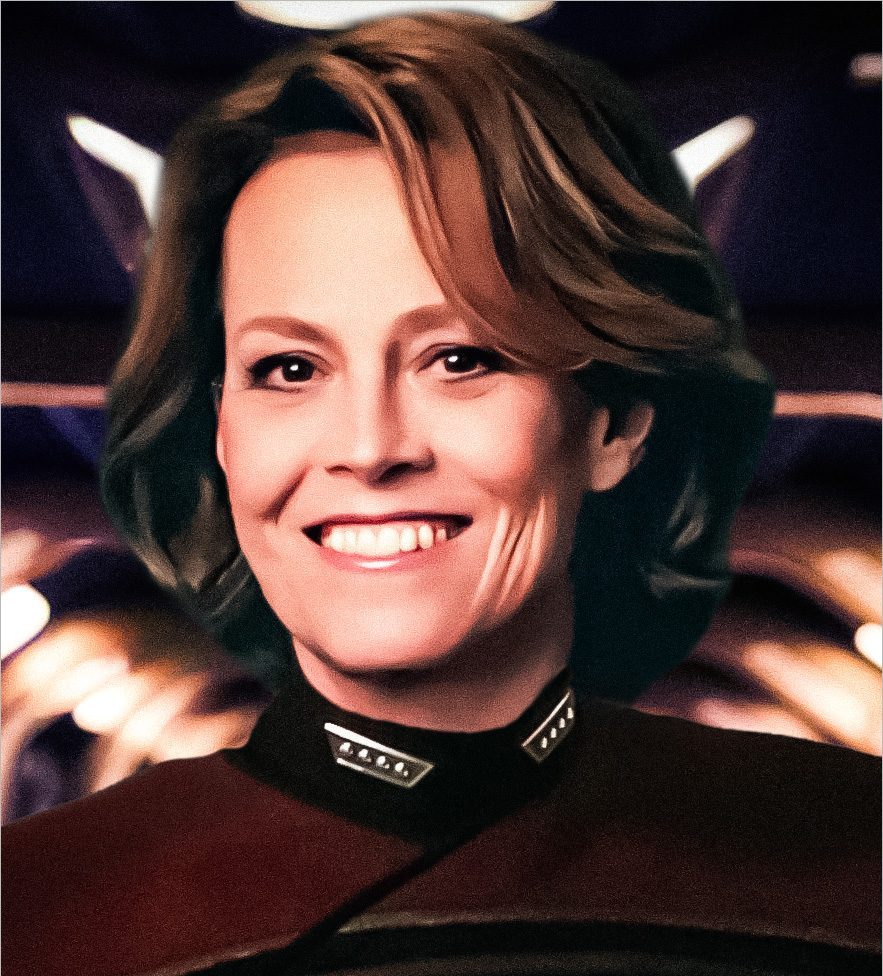







“Dropping out of warp, ma’am,” announced Chambers from the helm.
Sitting in her chair, Reyas looked up from the PADD that was in her lap down at the helm. “Slow to one-quarter impulse, Mister Chambers,” she ordered smoothly before gazing over at science to the left of her. “Lieutenant, anything on sensors?”
Jonarom nodded as he read out what he was seeing on his display. “I’m not detecting any Vaadwaur ships, but that’s not to say there are no underspace corridors nearby. However, I am picking up one M-class planet ahead, ma’am, with high amounts of trinimbic interference in its upper atmosphere. This isn’t going to be easy for us to search.”
“That’s strange,” Jirani commented to Reyas’s left. “Another world which the Briori inhabited and trinimbic interference exists. Could it be a coincidence?”
“Or just a smart strategy on their part,” Reyas concluded as she got up and walked over to Jonarom. “Lieutenant, can you determine whether the outpost’s location is safe to approach from this range?”
Jonarom was already one step ahead of his captain. By the time she reached him, she could already see on his displays that he was conducting the scan and attempting to push past the interference.“Unfortunately not, ma’am. The interference is dense and deliberately layered. We won’t see anything meaningful until we’re practically on top of it. Sensors, communications and transporters to and from the planet will be impossible to undertake.”
Sharing the same frustration she could see from her chief science officer, Reyas considered her options carefully as she placed her hands on her hips. She took one more glance over the scans that were live on Jonarom’s display. “There’s no way any of our shuttles or runabouts could survive the turbulence caused by that interference either. Looks like we’re going to take another page out of Admiral Janeway’s old book of tricks.”
Chambers looked over his left shoulder. “Blue alert, ma’am?” He asked, already smirking and eager to do what he had done several times before since joining the Ithaca.
Reyas chuckled at Chambers, also already preempting his captain’s decision-making. “Ryan, when did you and Jonarom start reading my mind?” She asked as she made her way back to her chair. The two young male officers chuckled back at her as she sat down again and nodded to Jirani to begin the procedure.
“Bridge to Engineering,” Jirani said after tapping her combadge. “We’re going to land the ship, Commander Jayshon. Take the warp core offline, vent all plasma from the nacelles and standby to engage atmospheric thrusters.”
“Mirab, with sails lowered and anchors set,” The Tamarian chief engineer replied calmly. “The journey pauses. The surface awaits.”
At the security and tactical station, Kurath spoke up in his typical gruff Klingon tones after opening a ship-wide intercom channel. “Lieutenant Kurath to all decks. Blue alert! We are preparing to land the ship. Get to code blue stations immediately!”
Chambers then spoke up from the helm. His fingers were dancing across the console with practised ease. He knew the procedure and had committed it to muscle memory. “Descent course plotted, captain,” he said, looking around one more time at his commanding officer. “How close do you want me to land us to the abandoned outpost?”
“At least five kilometres,” Reyas ordered. “If transporters cannot beam us after we’ve landed, then we’ll just take a short drive.”
“Aye, ma’am,” Chambers replied.
“The landing mechanisms are online, and I’ve set inertial dampers to maximum,” Mai announced from operations.
“Atmospheric thrusters are online,” Chambers shared. “We’re ready to go.”
“Take us down, Ryan,” Reyas said firmly. “Nice and gentle.”
The Ithaca shuddered as it crossed the threshold of the planet’s upper atmosphere, stars smearing briefly across the viewscreen before resolving into bands of cloud and turbulence. The hum of the engines deepened, no longer the smooth resonance of controlled spaceflight but the heavier, more physical vibration of mass meeting resistance.
Reyas lifted her head. “Report.”
Chambers leaned into the controls, eyes flicking between his display and the planet below despite the slight tremor now rippling through the deck beneath his boots. “We’re steady on our descent course. Atmospheric entry confirmed. Interference is causing some instability, but I’ve got it compensated, for now.”
As if to underscore the point, the ship lurched hard to port. A console near the aft stations spat sparks, its display flaring white before going dark. The deck pitched just enough to send a ripple of tension across the bridge.
Mai was already moving, fingers flying. “An electromagnetic surge just hit the hull and caused a brief overload in our secondary power grid. I’m diverting around the affected systems.”
The ship juddered again, then steadied, the vibration settling into something controlled, if still rough.
Chambers exhaled through clenched teeth. “Compensation holding. We’re back on track.”
The clouds thinned beneath them, revealing the mottled greens and browns of the surface below. The planet loomed large now, no longer an abstract sensor reading but a very real destination rushing up to meet them.
“We’re closing on the projected landing zone,” Chambers continued. “Visual range any second now.”
Reyas pushed herself upright in her chair. “Deploy the landing mechanisms. Start scaling back the inertial dampers and tune them to local gravity. Prepare to adjust environmental controls to the planet’s natural climate.”
A low mechanical resonance rolled through the hull as the ship’s landing systems extended, locking into place with a solid, reassuring clang.
“Landing mechanisms deployed and secured,” Mai confirmed. “Environmental controls standing by.”
The Ithaca descended the last stretch under atmospheric thrusters alone, engines throttled back as gravity asserted itself fully. The interference still clawed at the ship, but it no longer threatened to tear control away.
Instead, it felt like wrestling a stubborn animal into submission.
“Final approach,” Chambers said quietly. “Here we go.”
For a moment, the ship hovered just above the surface, the ground rising to meet her. Then, with a controlled settling motion, the Ithaca touched down. The impact was gentle but unmistakable, followed by the subtle groan of the hull adjusting to its new weight.
Chambers exhaled and pulled his hands away from the controls. “Thrusters offline. Engines secured. We’re down. Ithaca’s eighth landing in the Delta Quadrant!”
Reyas allowed herself a small, approving smile. “Well done. Now who is up for some fresh air?”
The Ithaca remained a distant presence on the horizon as the away team set out across the planet’s surface, two Argo-type ground vehicles kicking up low plumes of dust as they moved away from the landing site. The terrain was uneven but navigable, long stretches of hardened earth broken by shallow ravines and the skeletal remains of ancient structures that had long since surrendered to gravity and time.
As the captain had predicted, the atmospheric interference caused issues with transporters, making them unsafe to use without transporter enhancers in place. As a result, she called for a drive in the fresh air.
Reyas drove the lead vehicle, hands steady on the controls, her gaze fixed on the distant rise where the abandoned outpost had been identified. The vehicle’s suspension flexed and adapted beneath them, compensating for changes in terrain with quiet efficiency. Beside her, Kurath scanned the horizon with patience, one hand resting casually near his phaser rifle as though the planet itself might challenge them. Jayshon and Jonarom occupied the remaining seats, tricorders in hand, quietly comparing sensor readings as the outpost drew nearer.
The second buggy followed at a measured distance, Jirani at the controls. Doctor Corben sat beside her, one arm braced against the frame as the vehicle lurched slightly over broken ground, her expression already unimpressed by the planet’s attempts at hospitality. Behind them, the remaining security officers they had brought all looked as weary as Kurath did.
“This world has been left alone for a long time,” Jonarom noted, glancing up briefly before returning his attention to the data streaming across his display. “There’s no sign of recent surface traffic. No energy signatures beyond background interference.”
“That would be consistent with the other Briori ruins we’ve encountered,” Jirani replied over the open channel between the vehicles. “No long-term footprint.”
“If they abducted others from across the galaxy, then I’m not surprised they lost control. Eventually, the slaves will revolt!” Corben said dryly, “But someone went to great lengths to make sure that any of their remains aren’t helpful for anyone coming after them.”
The vehicles slowed as the terrain began to change. The ground beneath their wheels grew more compacted, faint geometric patterns visible beneath layers of dust and encroaching vegetation. What had once been deliberate pathways were now only suggestions, lines softened by centuries of neglect.
Reyas eased the lead buggy to a stop.
Ahead of them, the outpost rose from the landscape like a memory half-buried.
The team disembarked in practised silence, field duty jackets rustling softly as boots met the cold ground. The air carried a thin, persistent chill, not sharp enough to bite, but impossible to ignore, as though the planet itself remembered what had once stood here and resented the reminder.
From here, the ruins were unmistakable.
The air was colder here than expected.
“Atmospheric readings are within acceptable tolerances,” Jonarom reported, eyes flicking between the terrain and his tricorder. “No airborne toxins, no active radiation sources. This world is quiet.”
“Too quiet,” Corben muttered, pulling her jacket a little tighter. “That’s usually where the trouble starts.”
Ahead of them, the remains of the Briori outpost rose from the landscape in fractured layers. The structure had not collapsed all at once, but slowly, patiently, as if the planet had been dismantling it piece by piece. Walls leaned where they had once stood proud; support pylons jutted at odd angles, their bases swallowed by creeping vegetation. Metal and stone alike were scarred not by weapons fire, but by neglect and erosion.
Reyas slowed her pace, taking it in while she kept her tricorder open in front of her. “This matches the last Briori site we investigated,” she said quietly. “Same construction philosophy. Designs and patterns are almost identical.”
“Yes,” Jirani agreed as she walked over from her buggy towards the captain. “Layered architecture. Modular sections designed to be expanded or abandoned without destabilising the whole. This was never meant to be permanent.”
Jayshon crouched near a fallen column, his gloved hand brushing away lichen to reveal the faint sheen of composite beneath. “A camp beside the road,” he said. “Not the city at the journey’s end.”
Kurath stood slightly apart, scanning the perimeter with a predator’s focus. “A place left behind,” he rumbled. “But not forgotten.”
The four accompanying security officers established a perimeter with quiet efficiency, phaser rifles held low but ready. Their presence felt almost intrusive against the stillness. The outpost did not feel hostile. It felt finished.
Jonarom moved toward what appeared to have been the primary structure, tricorder humming softly. “There’s almost no functional technology left on the surface,” he said. “Power conduits are ruptured. Control interfaces are fused or physically destroyed. Whatever was here, it was rendered unusable on purpose.”
Corben arched a brow. “Which tells us someone cared enough to make sure no one came after them and picked through the leftovers.”
“Or,” Jirani said thoughtfully, “they wanted to ensure no one mistook this place for the destination.”
That earned a glance from Reyas.
Jonarom paused, eyes narrowing slightly at his readouts. “Captain, I’m detecting patterns in the damage. It’s not random decay. Systems were overloaded in a specific sequence. They burned out the surface infrastructure but avoided destabilising the structure entirely.”
Kurath’s lip curled. “They broke the blade,” he said, “but kept the sheath intact.”
Reyas put her tricorder away and folded her arms, gaze fixed on the ruin ahead. “I feel like we’re close to something here.”
They crossed into what had once been an entry hall. Sunlight spilt through the collapsed ceiling, illuminating specks of dust that drifted lazily in the air. The floor was cracked but intact, faintly etched with geometric lines that guided foot traffic centuries ago.
Jonarom knelt beside a shattered console, carefully brushing away debris. “This was a data access point,” he said.
“Or a relay node. Not a primary archive, but something that interfaced with one.”
“Anywhere else this interface would have connected to?” Reyas asked.
Jonarom shook his head. “Not locally. Whatever it was tied to, it wasn’t here.”
Corben crossed her arms. “So this was never meant to hold the answer. Just to point at it.”
Jayshon straightened slowly. “The signpost at the crossroads,” he said. “The road beyond unmarked.”
They moved deeper, room by room, corridor by corridor. Once again, empty workspaces. Storage chambers stripped bare. Living quarters reduced to frames and fragments, the personal touches erased from history.
“Exactly what was this outpost? It certainly doesn’t scream out as a research hub or a listening station,” Jirani concluded. “There’s no evidence of long-term habitation. No redundancies. No comforts.”
“No,” Reyas agreed. “This was a waypoint.”
Kurath turned, eyes sharp. “For whom?”
“For anyone following the right trail,” Corben replied dryly. “Which would explain why our last clue directed us towards here. It’s another reason why the Vaadwaur want to get to this place. They may know more than we do about what’s here. Perhaps this is the location they’ve been trying to find for so long.”
That shifted the air around them.
Jonarom looked up from his scanner. “If we’ve learnt anything about the Vaadwaur, and that is that they are methodical. They don’t chase myths unless they’ve been substantiated. If they’re coming here, then they believe this place matters.”
“But not because of what’s left on the surface,” Reyas said.
They emerged into an open courtyard, once carefully arranged, now overtaken by vegetation. At its centre lay a shattered plinth, broken clean through as if deliberately struck. Whatever had once rested atop it was long gone.
Jonarom circled the remains slowly. “This was ceremonial. Or symbolic.”
“A marker,” Jirani said. “Something that said: you’ve reached this point.”
Corben scanned the stone, frowning. “No residual energy. No radiation signature. If this held something once, it’s been gone for centuries.”
Kurath scanned the shadows beyond the courtyard. “Then why come here at all?”
Reyas stepped closer to the plinth, resting her gloved hand against its fractured surface. “Because like any good quest, the Briori didn’t scatter their clues at random,” she said. “They built chains. One location leading to another.”
Jonarom’s tricorder chimed softly.
He frowned, then tilted the device slightly. “Captain, I’m detecting subsurface voids beneath the structure. Artificial. Shielded from the atmospheric interference.”
Jirani’s head snapped up. “How deep?”
“Several levels,” Jonarom replied. “And whatever’s down there was protected far more carefully than anything up here.”
Corben exhaled, a thin smile forming. “Of course it was.”
Jayshon nodded slowly. “Bazminti, when he pulled back the veil,” he said. “The story under the dust, underground.”
Reyas straightened, decision settling over her like a mantle. “The surface was never meant to hold the answer,” she said. “It was meant to survive long enough to point the way.”
Kurath’s grin was unmistakable. “Then what we seek lies below. Waiting for us.”
“Yes,” Reyas replied. “Not the outpost. The clue it guards.” She looked around at the ruin one last time. The broken walls. The empty halls. The deliberate absence. “Document everything we can up here,” she ordered. “Then we find a way to move below.”
The team all acknowledged as one.
Beneath their feet, something waited for them.