










Summary
Lieutenant Junior Grade Vamav serves as squadron leader of Northeast Squadron, also known as the Nor’easters. From the cockpit of a Valkyrie-class starfighter, he directs reconnaissance patrols, long-range sensor sweeps, and rapid-response flight operations that expand the Hurricane’s awareness beyond the limits of the ship’s primary sensors. His role requires constant coordination with flight control, tactical, and operations to ensure that small-craft movements support broader mission objectives.
The Nor’easters function as both scouts and shield. Their fighters move ahead of the Hurricane during uncertain approaches to identify hazards before the larger ship commits itself. In periods of heightened tension, the squadron forms an interception screen designed to place maneuverable craft between the Hurricane and potential threats. These patrol patterns demand precise timing and disciplined formation work. Vamav reinforces these skills in his pilots through rigorous training.
While reconnaissance remains the squadron’s primary mandate, Vamav continues to prepare his pilots for interdiction scenarios. He studies engagement doctrine and runs simulations that emphasize coordinated strikes and defensive coverage for vulnerable assets. Beneath his steady command presence rests a clear personal ambition. He hopes to prove himself under real combat conditions and demonstrate that the Nor’easters can serve as a decisive protective layer for the Hurricane.
Until that moment arrives, he trains, patrols, and keeps his squadron ready.
Appearance
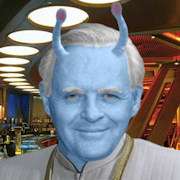
Lieutenant Junior Grade Vamav stands at 6’1 with the athletic build expected of a starfighter pilot. His long, lean frame is shaped by constant conditioning. His shoulders are broad, yet his frame does not appear bulky. His movements carry a natural balance that makes his casual stride look effortless. He radiates relaxed confidence as he quickly covers ground.
Vamav’s wide, rectangular jaw defines the lower half of his face. A square chin becomes more pronounced as he tightens his symmetrical facial features. Crimson irises hold a steady warmth beneath thick brows tinted a shade deeper than mint green. Those eyes often narrow with quiet amusement before he smiles. The same gaze can sharpen into aggression when challenged.
His complexion is a layered yellow-green mottled with deep copper undertones. This casts a early golden glow across portions of his face. These markings identify him as part of a rare Orion sub-lineage once referred to as Ruddy Orions. The gold coloration gathers most prominently between his cheeks and continues down the center of his neck.
Fair green hair rises in a high mass of tangled curls. It is trimmed short around the ears and along the lower rear of the scalp to loosely satisfy regulation. Small ears sit partially revealed beneath the cut. His expressions shift easily between smug satisfaction, broad laughter, and disarming smiles that arrive quickly and fade just as fast.
There is a readiness about him, as if he expects to be called to his fighter at any moment.
Personality
Lieutenant Vamav approaches his role with intensity. He studies tactical briefings longer than required and frequently reviews engagement recordings to refine his technique. In squadron drills, he pushes formation partners to tighten flight patterns, sharpen response times, and anticipate maneuvers before they are called. He speaks directly during critiques and expects the same candor in return. Within the Nor’easters, his presence often raises the overall tempo of training.
Confidence is evident in the way he carries himself and in how quickly he volunteers for complex assignments. That confidence sometimes borders on arrogance, though it is grounded in preparation and trust in his squadron. He trusts his hands, his instincts, and the fighter beneath him. Risk is something he calculates rather than avoids. Stress rarely shows during operations, but after extended deployments he seeks outlets that allow him to decompress. He attempts moderation with alcohol and other distractions, yet there are moments when discipline gives way to the need for release.
Vamav measures much of his identity through performance. He is aware that survival in a starfighter depends on precision, awareness, and reaction times measured narrowly in fractions of seconds. This awareness keeps him focused on self-improvement. His training habits and competitive drive hint at his ambitions to be seen as a top pilot. One of his goals is to become a fighter ace by downing at least five enemy craft.
His heritage shapes many of his social interactions. The distinctive markings of a Ruddy Orion draw attention in crowded spaces. Some Orions respond with fascination. Others show quiet resentment tied to old cultural hierarchies. Vamav acknowledges both reactions without openly addressing them. He maintains his composure, not seemingly bothered by the thoughts of others.
Away from flight operations, Vamav sometimes reflects on how the cockpit has narrowed his world. Friends see less of him than they once did. Invitations are declined in favor of simulator hours or tactical review sessions. He recognizes the change and occasionally attempts to reconnect. Duty often takes precedence. Beneath the disciplined exterior remains someone who wants to relax and feel less defined by expectations.
Among the Nor’easters, Vamav is known as a pilot who will press the limits but never lose sight of the mission. His callsign, “Ruddy,” is spoken with equal parts respect and familiarity across the squadron channels. When he launches, others trust that he will hold formation, guard their flanks, and return home with them.
History
Vamav was born in 2379 on Kolar, known to the Federation as Beta Rigel VI. His childhood unfolded beneath the layered expectations tied to his Ruddy Orion lineage. The copper undertones in his complexion and the distinctive coloration along his face marked him as part of a bloodline that had once held favored standing within segments of Orion society. Though those hierarchies had faded, memory lingered. Some residents treated him with quiet resentment. Others extended privileges he had done nothing to earn. Shopkeepers occasionally spoke to him with thin patience, while others slipped him extra food or small gifts simply because of what he represented.
Even as a boy, Vamav recognized the difference in how people reacted to him. He chose early to focus on those who welcomed him and to dismiss those who did not. That decision shaped his temperament. He grew comfortable meeting attention head-on and rarely backed away from confrontation. Schoolyard disputes were common until he formed his first circle of friends. He learned unity carried more strength than solitary pride. This would later define his approach to formation flying.
Athletics provided his first structured outlet. Vamav excelled in Orion track and field competitions, where his speed and endurance drew notice across regional youth circuits. Victories in junior games on Kolar brought him early recognition. During those same years, his uncle started to teach him the fundamentals of flight and basic small-craft maintenance. Lessons took place in modest hangars and aging training vessels. He barely maintained average grades in class despite his hardest efforts. Physical performance and spatial awareness were where he distinguished himself.
Recruiters from Starfleet Academy took interest after reviewing his athletic record and preliminary flight hours. He was offered admission with placement into a flight-oriented training path. At the Academy, Vamav studied under former Captain Matt Smythe, a veteran starfighter pilot whose combat experience dated back to the Dominion War. Smythe emphasized discipline, awareness, and the importance of reading an opponent before committing to a maneuver. He introduced cadets to tactical patterns that had once been tested under battlefield conditions. Vamav absorbed as much of the lessons as he could. Under Smythe’s instruction, the young cadet blossomed into a capable pilot.
By the time he graduated, Vamav expected his career to focus on active combat. For nearly two years, he remained in a mostly defensive posture stationed at Starbase 21. Alert scrambles occurred often enough to keep his skills sharp, yet true engagements rarely materialized. On a handful of occasions, he powered weapons and tracked hostile signatures but never took a shot. When the Blackout disrupted communications across vast regions of space, Vamav flew extended patrol patterns in search of Vaadwaur activity. His fighter never encountered them. The absence left him with a mixture of relief and lingering frustration.
In early 2403, orders reassigned him to the Typhoon-class USS Hurricane as it departed Starbase 21 to rendezvous with the USS Cardinal for crew transfers. The posting placed him among a newly organized Valkyrie squadron tasked with extending the ship’s reconnaissance and defensive reach. For the first time in his career, he found himself positioned where readiness might quickly turn into action.