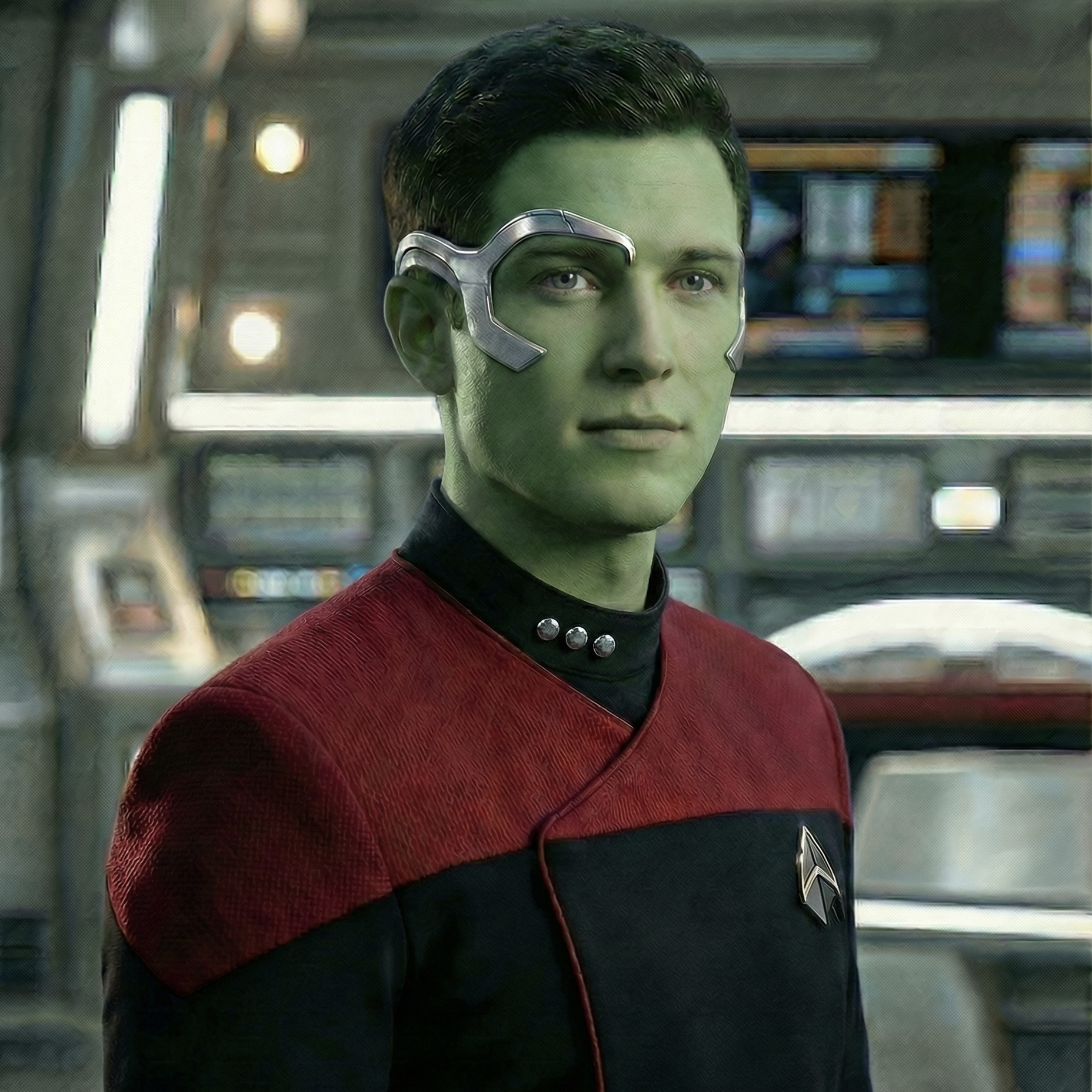







USS Appalachia sat motionless, thrusters puffing to keep her on station approximately 100 kilometers to the still and dark form of the transport Kalanthos as the tidal forces within the upper-to-mid atmosphere of the gas giant Ramalchis VI buffeted both ships. Her hull creaked and groaned under the pressure of the planet’s significant gravity, the augmented structural integrity field and her own strong bones holding – for now – against the force of the liquid hydrogen that sought every moment to breach her interior. Standing on his bridge, unable to sit still, Commander K’lev rested one green-skinned hand for a moment on the bulkhead, next to his ship’s dedication plaque. You’re doing great, old girl, he thought, almost communing with the ship for a moment. Keep it up; you’ve got this.
His heart rate slightly calmer after the moment’s reverie, he turned around, regarding the rest of the assembled members of his senior staff. “Okay, we’ve found her,” he began, taking a deep breath. “First thing’s first, I think… What’s our status?” he finished, mismatched blue-grey eyes settling on Lieutenant Tiza at Ops.
Tiza glanced down at his console, checking the displays before responding. “Nothing’s down at the moment. Structural integrity’s holding for now, but I’m not sure it’ll keep on doing so if we go any deeper.”
“Then let’s stay here, if we can,” K’lev said in the direction of Lieutenants Phillips and Sarai, who both nodded in response, as he moved back towards the center of the bridge. “Any dangerous conditions on sensors?” he asked, now addressing Lieutenant Sigurdsson. “Other than ‘the atmosphere of a gas giant’,” he finished with a chuckle.
The quip sent a ripple of laughter around the bridge, an effective means of breaking at least some of the moment’s tension. The science officer shook his head. “Nothing immediate,” he replied. “I’m monitoring several areas of increased convective activity, but they currently seem to be tracking away from us.”
“What about the Kalanthos?” Lieutenant Commander Lotharys asked, looking between Sigurdsson and Tiza. “Can you tell anything about what happened to her?”
“From what I can tell, she doesn’t appear to be emitting any radiation, but sensor range and resolution are badly degraded,” Sigurdsson reported.
Tiza nodded his agreement. “I can see that she’s there, and I’m not reading any power signatures or transponder codes, but that’s about it.”
Sigurdsson seemed to have an idea then. “Tiza, what if we pointed some of the hull cameras at her? A visual inspection might still be useful.”
The Xahean nodded slowly. “Yeah… yeah, that could work! One moment,” he said, bending over his console as his fingers tapped away at the controls.
Every eye turned towards the viewscreen as the ship’s forward hull cameras began to zoom in on the ethereal form of the Kalanthos, drifting through clouds of methane and other hydrocarbons like a ghost among the mists. The gas giant’s swirling atmosphere made a visual inspection difficult, but in spite of this some details soon made themselves known. It appeared that Kalanthos had suffered. One of her nacelles was missing, the end of its strut bearing the tell-tale hallmarks of a compression failure of the hull plating and frame. Something around her impulse engines looked strange as well; it was hard to tell for certain what was off, but something about it made K’lev’s hair stand on end. The hull also showed evidence of scoring, likely caused by the ambient static discharges that periodically streaked across the sky – and occasionally slammed into Appalachia’s shields, though they were holding for the moment.
Lotharys must have noticed the uncomfortable look on K’lev’s face, because she crossed over to stand beside him. “What’s up?” she asked.
“Dunno… Something feels a bit off, but I can’t place it,” he replied. “At least it doesn’t look like she’s been holed, so maybe some of her crew’s still alive?”
“Let’s hope so,” Lotharys replied, her fingers brushing his for a moment before she turned to address Tiza. “Please put a boarding party together; medical and engineering personnel, I think. They should probably wear environmental suits, just to be safe.”
K’lev nodded his agreement. “Passing the word now,” Tiza said, beginning to relay the instructions through his console. Meanwhile, K’lev turned towards Phillips and Sarai. “Think you two can get us closer, within safe beaming range?”
The two lieutenants exchanged glances. “Yes, sir,” Sarai replied, speaking for them both.
“Then go for it, nice and easy. Tiza, let us know when you can get a good transporter lock, yeah?”
“You got it,” the Xahean answered.
Appalachia’s thrusters fired, bringing the venerable Steamrunner-class vessel closer to her quarry. Proximity brought more clarity as it removed some of the haze that partially obscured Kalanthos’s form, a clarity that set a pit forming in K’lev’s stomach. Kalanthos’s impulse engines showed signs of significant carbon scoring, as did the remaining duranium at the end of her broken nacelle pylon, and it seemed that the ship’s hull was more badly scored than had been previously thought. But what drew K’lev’s eye – and indeed every eye on Appalachia’s bridge – was a gash, clean through the hull near the transport’s bridge and close enough to have potentially compromised it. She had, it turned out, been holed at least once.
“We’re in transporter range,” Tiza said after a moment, his voice muted.
“Is the away team ready?” Lotharys asked.
Tiza nodded. “Then beam them over, and hopefully we can get out of here soon.”
The away team, numbering four people in total, materialized in a compartment both deserted and dark. Kalanthos was not a large vessel – she measured perhaps no longer than 70 or 80 meters in length – and so the sounds of the team’s environmental suits atmospheric recirculation systems, and even their footfalls, took on an ominous, echoing quality that left the four sitting on edge in very short order. Lieutenant (jg) Williams, a member of Lieutenant Commander Pelix’s engineering team and the team leader, cleared her throat. “Ensign M’Laaza, head up to the bridge and see if you can access the ship’s logs in local memory; I’ll check the warp core, then look for the test probe. Nurse St. Pierre, Ensign Lopez, see if you can find any survivors. We’ll meet up back here in one hour.”
Three helmeted heads nodded, then the quartet split up about their various assignments. Williams made her way aft, forcing open the door to the ship’s small engineering compartment. The warp core itself was cold and dark, the ship’s secondary fusion reactor similarly inert. Even the ship’s emergency batteries had bled dry, and a lump formed in Williams’ throat at this confirmation that if anyone had survived whatever had happened to Kalanthos they likely were no longer among the living. It also confirmed, equally worryingly, that the only thing keeping Ramalchis VI’s atmosphere at bay at this point was the transport’s own hull and bulkheads, her structural integrity field and emergency forcefields non-functional with the lack of power to their emitters.
Her bootsteps heavy with momentarily-suppressed dread at what the away team would find, Williams began to move further aft, looking for a Jeffries tube. Kalanthos had been modified to carry a single forward-firing full-sized probe launcher underslung on her belly, with access to the launcher via the tubes that ran through many Federation-built ships for maintenance access. Her search took a few minutes, but soon she did locate a tube access hatch; opening it, Williams began to crawl through the confined space – made more so by her bulky environmental suit – and making her way towards the probe launcher.
Nurse St. Pierre and Ensign Lopez, the away team’s two representatives from Appalachia’s medical division, began a somewhat meandering exploration of Kalanthos’s interior. While Williams and M’Laaza had direct objectives that could be achieved – theoretically – at direct locations, the nurse and her medtech were instead on a general search for survivors. Both knew that it might be a futile mission, but neither was willing to give up the chance that someone might be left alive.
Kalanthos was not a large vessel, and so locating the crew cabins was a fairly simple prospect. The doors were all closed, and failed to react as the two medical officers approached the limit of their proximity sensors. St. Pierre and Lopez exchanged worried looks, then approached the first of the cabin doors. Through the gloves of their environmental suits, prying off the access hatch to the manual override was not an easy task, but with time and perseverance they managed, and with the override engaged, opening the door became a far simpler task.
The cabin inside, a smaller space, was a bit of a mess. Some pieces of decor – a lamp, some bottles of some sort of beverages, a PADD, and other trappings and personal touches – had either fallen over or been knocked over during whatever had befallen the ship, but the cabin was otherwise in fairly good order. They moved into the room, tricorders out and scanning in case a badly hurt crewman might be hidden out of direct sight. The cabin was empty, but the tricorder was detecting a nearby biological signature; with a start, St. Pierre and Lopez realized that it was coming from an adjoining cabin.
Crossing quickly back out into the corridor, it was but a few steps down to the next compartment. Perhaps a minute of effort later, and that cabin’s door was open. Physically, it was in a similar state to the previous one: a bit disheveled, but not excessively so as if it had been ransacked. What drew the two medical officers’ attention, though, was the form lying draped across the bed. It appeared to be a Risian man, lying unnaturally still with one arm spilling over the edge of the bed. St. Pierre crossed quickly, taking out her tricorder and scanning his form, before looking towards Lopez and shaking her head. The Risian was dead, the cause of his demise evidently oxygen deprivation based on the medical tricorder’s report.
Ensign M’Laaza, an engineer’s mate by training, made his way forward and one deck up towards Kalanthos’s small bridge. As his superior had discovered on her way to engineering, Kalanthos seemed to be abandoned, yet she was too small to carry effective escape pods. The walk was a solitary one, M’Laaza’s bootsteps echoing down empty corridors that left the Caitian alone with his thoughts. Those thoughts inevitably turned inwards, as his mind began to speculate on what might have taken place aboard this ill-fated vessel, and the ideas coming to him were less than optimistic.
A brief crawl up through a Jeffries tube left M’Laaza standing outside a door that was quite clearly sealed. Part of the bulkhead was scorched and deformed, bulging downwards into the corridor, and even through the sounds of his environmental suit’s systems he could hear the rush of Ramalchis VI’s atmosphere on the other side of the duranium paneling. Clearly, whatever had smashed open Kalanthos’s hull had torn her bridge open. M’Laaza activated his communicator. “Ensign M’Laava to Lieutenant Williams. Ma’am, the bridge is compromised; I can’t enter without flooding the entire deck.”
“Understood, Ensign,” came Williams’ voice after a moment, sounding distracted; indeed she was busy, presently beginning her own claustrophobic crawl towards the mounted probe launcher. “Do you think any logs might be recoverable?”
“No, ma’am,” he replied, hanging his head; while Kalanthos was not a Starfleet vessel, he still felt for her small crew, some of whose remains might be sealed behind that door inside the decompressed and flooded bridge.
“Start making your way towards engineering. I’m nearly to the probe launcher; if the probe’s still there, I’ll need your help prepping it for transport.” Williams manipulated her own communicator, adding St. Pierre and Lopez to the channel. “Any survivors?”
“We’ve found three bodies so far,” St. Pierre answered. “I don’t think any of the crew made it, sir. Everyone we’ve found appears to have died of oxygen deprivation.”
“Understood,” Williams replied as the sounds of a Jeffries tube hatch opening came over the open channel. “All of you, start making your way back to main engineering. I’ll let Appalachia know.”
It had been perhaps a half an hour since Williams had relayed word that Kalanthos was a ghost ship, her engines permanently offline and her crew dead. The news had left a shadow hovering over the bridge of the Appalachia, each officer now forced to confront the simple reality that it might not take much for the Starfleet vessel to find herself in a similar predicament. K’lev found his leg bouncing restlessly as he sat in his chair, and trying to still it only set his fingers to drumming on the armrest instead. So he stood, pacing around the bridge in the hopes that perhaps movement might settle his nerves better than silence. Lotharys watched him walk for a moment, reaching out a hand to catch his arm as his stride brought him within her reach. “You okay?”
He nodded, albeit a bit hesitantly. “Yeah… Just trying to stay out of my own head, y’know?”
She nodded. “Me too… I don’t think it’ll happen to us, though; I mean, we’re a bigger ship, so we should be able to manage if something happens.”
A half-hearted half-smile pulled the right side of K’lev’s mouth up. “No, you’re right; doesn’t stop me from worrying, though.”
Lotharys smiled gently, though the moment was interrupted as an alert sounded from Tiza’s console. “The away team’s secured the probe, and are ready to beam back,” he said, perhaps more solemnly given the tragic news from the transport.
K’lev nodded, stopping by the edge of the caprail. “Lower shields, and let’s beam them back. Then let’s get out of here.”
“On it,” Tiza replied, beginning to input commands into his console.
As with all Starfleet vessels, Appalachia had to lower her shields to be able to beam further than intraship site-to-site. Fortunately, the transport would only take a moment to complete, then she could re-raise her defenses and begin the climb back into orbit, leaving the drifting and lifeless hulk of the Kalanthos to its inevitable fate: soon enough, it would be drawn into an area of downward convection, pulled beyond its hull’s ability to withstand the atmospheric pressure, and crushed. However, fate had other plans.
The only warning that something was amiss was a sudden alert from Sigurdsson’s console, drawing the science officer’s gaze suddenly downwards. His eyes widened. “Sir, I’m picking up a massive-”
BAMBAMBAMBAM!!!!!
Appalachia pitched violently as no fewer than four massive energy discharges hammered her hull. All aboard were sent either reeling into consoles if they were seated or flying if they were standing. Down in main engineering, the warp core flickered precipitously, but its automatic safety features engaged and shut it down, purging the reaction chamber before there was even a risk of a catastrophic containment breach. That did not protect her power relays, though, as energy surged through them well beyond their rated capacities and caused blowouts throughout the ship that sent instantly red-hot debris flying through the air, into both furniture and flesh. Emergency lighting kicked in after a moment, bathing compartments and corridors alike in a red glow that, considering the sudden damage the ship had taken, made her interiors appear soaked in blood. A pall of smoke hung in the air, its acrid scent merging with the odor of ozone from electrical shorts and fires, and the more sickly smell of burned bodies.