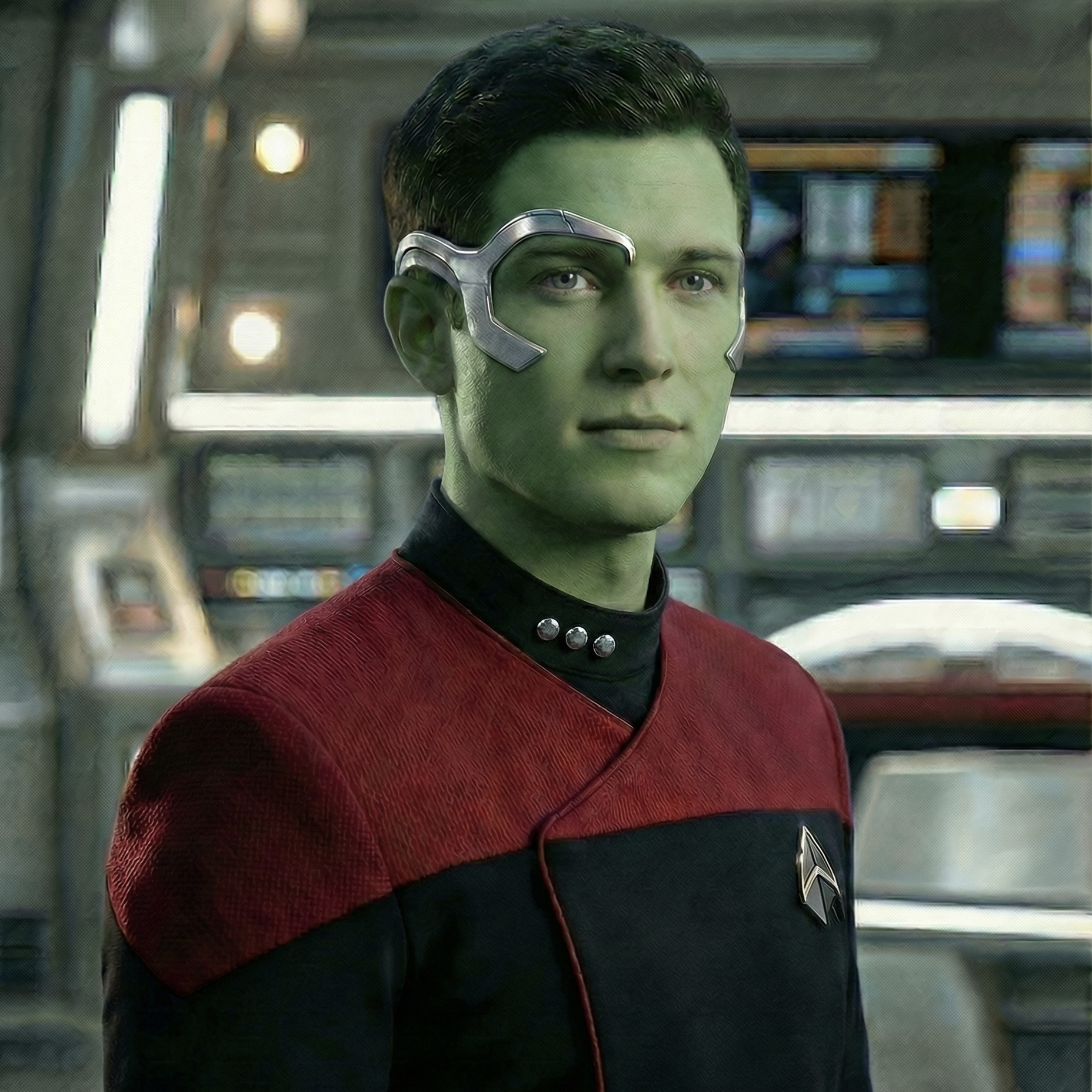






Doctor Stivir, chief medical officer aboard USS Jemison, sat at the desk in their office, their brown eyes fixed on the desktop display as they worked to finish the itinerary for the first iteration of exercises. All of their support personnel – a lower-ranked doctor, four nurses, and twelve medtechs – had been busy since coming aboard, unpacking, inventorying, and stowing supplies, then calibrating their equipment. That process was now completed.
Completing their work, Stivir stood, walking around their desk to exit the office. The main bay itself was busy, in the way of a sickbay with no major maladies to treat or crises to meet. There were three others currently in view: a nurse was in the process of treating one of the lower deck crewmen, who was suffering from a bout of nausea, while a pair of medtechs rechecked pharmaceutical inventories. On the whole, it was a quiet afternoon.
Stivir nodded, then stepped back into their office and tapped their combadge. “Doctor to bridge,” they said.
“Go ahead, doctor,” came El Hanif’s voice from the speaker.
“Commander, we are prepared to begin our drill.”
“Very well. Coordinate your timetable with Lieutenant Teller directly; she will run the drill from here.”
“Understood. Stivir out.” Resuming their seat, the Vulcan doctor reactivated their console and sent a brief message to Teller’s console: Begin drill in 90 seconds.
Seated at the secondary Ops station, forward-most of the three stations along the bridge’s starboard bulkhead and configured for Damage Control, Teller’s back straightened. She composed a brief response – Understood – then started a silent countdown clock. She didn’t actually need it, but that didn’t mean it wasn’t still helpful, even if only as a reminder. Fortunately, this was a medical drill only, designed to allow sickbay staff to familiarize themselves with operating their new facility under stress; while this first pass would be built around a theoretical large-scale shipboard crisis, her own damage control teams were not active.
Teller then nodded to El Hanif, who activated a shipwide intercom channel. “All hands, this is the bridge. We are about to begin a medical training exercise. Assume that all reports are associated with the drill and continue normal operations; in the event of an actual emergency, the report will begin with ‘actual casualty’. Stand by for the medical exercise.” She then closed the channel, before nodding towards Teller.
As the timer ticked down the last few seconds, Teller opened a shipwide intercom channel. “Attention all hands, medical emergency in the primary chemistry lab. There is a hazardous sample containment failure. This is a drill.”
Hearing the announcement, Stivir stood and strode from their office. “Confirm with Operations that the chemistry lab is secured and sealed,” they ordered one of the two medtechs on duty, tone level and deliberate, before turning towards the second tech. “Activate biobeds one through four, and stand by on six through ten. Nurse,” they continued, attention shifting once more, “prepare for incoming wounded. Anticipate potential chemical burns and substance inhalation, and initiate triage procedures.”
The staff present – one nurse and two medtechs – immediately leapt into action. One of the techs tapped their combadge and began to speak with Teller, ensuring that the lab was quarantined to avoid the spread of the simulated contaminant through open doors or air recirculation. Meanwhile, the other started moving from one biobed to the next, bringing four of them to full operation and configuring them for diagnosing and treating the various ailments and injuries that could arise from an accident in the chemistry lab.
As the on-duty team worked, Stivir opened an intercom channel from a nearby wall console. “Sickbay to second-shift medical staff. We are responding to a medical emergency; stand by for orders. Out.” With one message relayed, and assistance now preparing to be called in, they tapped their combadge. “Stivir to Transporter Room One. Begin emergency transport of chemistry lab staff to sickbay.”
“Yes, sir,” the chief petty officer on duty in the transporter room replied.
Within perhaps fifteen seconds at most, the hum and glow of transporters heralded the arrival of the ‘injured’ lab technicians. Before the drill started, each tech had been given a wearable tag that they were to wear on designated parts of their bodies; the tags contained data for the medical team, identifying what sort of simulated injuries each technician had suffered. The biobeds would be able to read the tag, and it included instructions for the bed to report each vitals for each ‘patient’ as though the tag’s diagnosis was truthful.
With patients now coming in, sickbay became a hive of activity. Stivir joined the nurse on duty – Giovanni da Firenze, a human man – in moving quickly yet deliberately from biobed to biobed, taking preliminary readings and tasking the two medtechs to retrieve various hyposprays and treatment devices, based on what each casualty tag told the biobed to report. The two techs, in turn, were moving quickly to and from the supply room, staging supplies for the doctor and shift nurse to apply to their charges. As this was a drill, naturally the hyposprays were not loaded with actual medications but test articles, and their injector functions had been temporarily disabled, but a second set of hyposprays had been set aside in case an actual emergency arose during the drill.
Of the four beamed into sickbay, only one was simulating a severe injury, inhalation of caustic chemicals; the casualty tags assigned to the other three all reported more minor problems. They were quickly “treated” and discharged, while the fourth was marked as being held in longer-term care. Granted, in this case that simply meant being held in sickbay until the end of the drill. A few minutes after the third “patient” was discharged, the intercom crackled to life again. “Cargo Bay 1 to Sickbay,” said a voice over the speaker. “There’s been an accident down here; a stack of crates fell over and landed on two of my people!”
Stivir nodded. So far, they saw no need to call in a second shift; the first casualties were a bit of a challenge, but one to which their on-duty staff had risen quite adeptly. The Vulcan doctor tapped their combadge. “Doctor Stivir to Transporter Room One. Two casualties in Cargo Bay 1, emergency transport to sickbay,” they ordered, voice level and steady.
“Energizing now,” the voice replied.
A moment later, and with another wash and hum of energy, two figures materialized, each on one of the recently-vacated biobeds. Immediately, Stivir and da Firenze moved to begin their examinations. According to the tags carried by the two crewmen, both had suffered concussions and various significant crush injuries, and one – the one who had been further from the base of the “collapsed” stack – was also bleeding inside their skull. The team quickly got to work, Stivir and one medtech working to try and stop the simulated brainbleed while da Firenze and the other began to set limbs that had been “crushed” in advance of osteoregenerator application.
On Stivir’s recommendation, this part of the drill included a wrinkle, and it now made itself known; only one of the osteoregenerators actually functioned. In truth they all worked, but all save the one had been switched off, though it could be quickly brought online if actually needed; the one “working” one was simply on standby. “Doctor! Only one regenerator seems to be having an effect!” da Firenze called.
Stivir nodded, their attention focused on the subdermal tissue growth accelerator and the vascular stimulator that they were simultaneously “using” to treat the simulated bleed. “Focus your efforts on the most severe injuries,” they said over one shoulder, their controlled tone contrasting to the nurse’s more urgent voice. “Stabilize, then conduct detailed treatments.”
“Yes, doctor!” The three replied in unison.
Only a few moments later, the intercom came to life again. “Sickbay, bridge,” Lieutenant Teller said. “We’re showing a radiation alarm in the port impulse reactor compartment.”
“Understood,” Stivir replied, continuing their work. “Second-shift medical personnel to auxiliary sickbay,” they ordered in the direction of one of the medtechs, who stepped away to relay the order. “Transfer radiation casualties to secondary sickbay, quarantine protocols until decontamination is completed.”
Glenn-class starships like Jemison carried a second, small sickbay near the shuttlebay. It wasn’t as large as the main compartment, but it was just as well-equipped, at least for monitoring and medical treatment; it lacked a surgical suite, though, requiring such interventions to be conducted in the main sickbay. Typically the auxiliary sickbay was only used when the primary sickbay was inundated with wounded, but for quarantine purposes – either simulated, as in this case, or actual – it was quite handy.
Within minutes, the crew from the port impulse reactor room had been beamed to the auxiliary sickbay and were under the care of the just-arrived secondary medical team, led by Doctor Kal’wari, a female Denobulan lieutenant and the ship’s second doctor. The second-shift team swiftly began treating them for their simulated radiation exposure. The anti-radiation medication was quick to administer, but – at least in an actual emergency – time would be the deciding factor in recovery. In this case, though, of the six people monitoring the impulse reactor, only half of the tags specified a longer return time.
On the bridge, Teller had been keeping track of the drill’s status; once a patient’s ailment was fully treated, their casualty tag was deactivated, so she could monitor the exercise by which tags were where and how many were no longer active. Seeing the progress meter right where it had been expected to be, she turned towards El Hanif. “Sickbay’s hitting their margins perfectly, Commander. We’re ready for the final phase.”
El Hanif nodded. “On your word, then, Ms. Teller,” she replied.
Teller straightened in her seat, then activated the shipwide intercom once more. “Bridge to sickbay. Plasma fire in main engineering. Transporters are offline.”
“Acknowledged, bridge,” Stivir replied; the transporters being offline for this last phase was news to them, but they were too disciplined to allow it to rattle them. “Activate third-shift medical personnel, and deploy to engineering. I will join them there. Nurse da Firenze, continue treatments here,” they bade as they quickly – yet deliberately – retrieved a portable medical kit, plus spare dermal regenerators, subdermal tissue growth accelerators, and several extra hyposprays of painkillers.
It was a relatively convoluted trip from sickbay to main engineering. From deck 5, Stivir’s turbolift had to pass from the saucer’s outer ring to its core, then aft into Jemison’s small neck and down to deck thirteen and the lower-level access to main engineering. Fortunately, the chief medical officer’s command codes enabled a medical override of the lift car’s functions, granting Stivir an express ride to their destination, and so while the trip was convoluted it was not necessarily long, at least by the standards of a Glenn-class vessel.
The third-shift medical team – one nurse and two medtechs – had already arrived by the time that Stivir made their way into main engineering. Once inside, the doctor swiftly took control of the situation, orchestrating the triage effort with the assistance of Lieutenant Commander Teil. In short order, the engineering staff were being sorted into three groups, based on the scans of their casualty tags: the severely injured, who needed immediate treatment; the moderately injured, who needed care relatively quickly but weren’t in immediate danger; and the mildly wounded or unhurt, who could resume their stations.
The order of the day in engineering, by Stivir’s directive, was stabilization. The portable medical kits were capable enough, but they were no substitute for a proper sickbay after all. However, they were enough – or they would be, in a true emergency situation like this simulation – to allow the medical staff to try to stabilize the wounded long enough to arrange transport to sickbay. The third-shift medical team was more than up to the task, but part of this phase of the drill was an important lesson: even one’s best efforts, sometimes aren’t enough. In this case, almost half of those whose tags marked severe injuries were secretly tagged further as fatalities after unsuccessful stabilization.
With everyone else tagged as stable for transport, Stivir tapped their combadge. “Doctor to bridge. Situation stabilized; final count, 5 fatalities, collective 22 wounded.”
“Understood, Doctor,” El Hanif replied, “and well done, to you and your team, on a successful exercise. Please reset your equipment and submit your formal report for dispatch upon our arrival at Starbase 86.”
“Yes, Commander. Stivir out.”
With the channel now closed, El Hanif nodded to Teller, who keyed the intercom once more. “All hands, this is the bridge. The medical training exercise is now concluded. You may resume normal duties. Fourth-shift medical team, report to sickbay for relief duty.”