 Bravo Fleet






Ralston and Travers walked into Cyclone’s medical complex.
It wasn’t quiet. It never was. Biobeds hummed, instruments clicked, and medical personnel moved with the careful pace of those who knew that rushing only made things worse. This was a place that stayed busy because stopping wasn’t an option.
A nurse glanced up as they entered.
“Who is the duty officer?” Ralston asked.
“That depends on how bad the bleeding is.” A voice answered from behind a partition, dry and unamused.
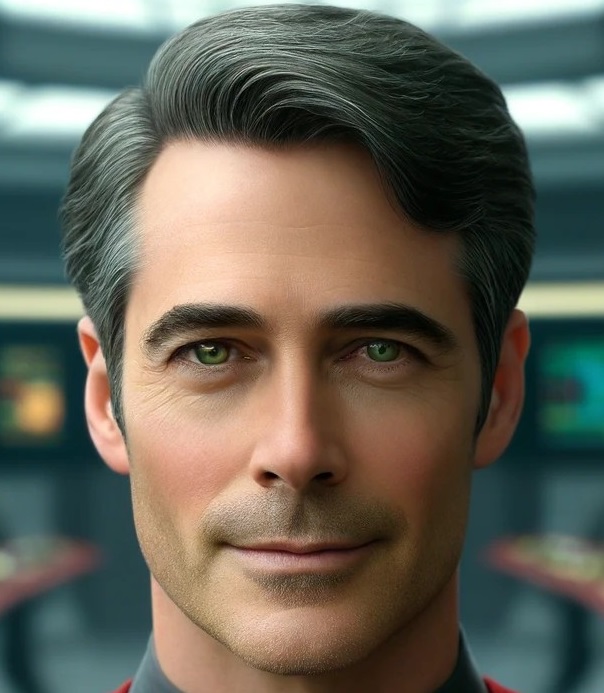
The man who stepped into view looked like he belonged to the ship in a way few officers ever did. Broad-shouldered, solid, with the stance of someone who had spent too many hours standing over bodies that refused to cooperate. His hair had gone entirely to gunmetal, his jaw permanently shadowed with stubble, and his eyes glared with a transparent, steel green that missed nothing and forgave very little.
He held a PADD in one hand and a mug in the other. The coffee was strong. The man was stronger.
“Commander Branson Kittredge,” he said. “Senior Medical Officer.”
Travers inclined his head slightly. “Bran.”
Kittredge didn’t return the gesture. His attention stayed on Ralston, measuring him as surgeons measure patients: quickly, unsentimentally, without regard for comfort.
“You must be Hardin’s new problem,” Kittredge said.
Ralston stopped in front of him. “Commander Logan Ralston.”
. “Yeah. Iron Veil didn’t exactly keep a low profile.” Kittredge snorted unsympathetically.
“What shape is your department in, Doctor?” Ralston asked.
Kittredge took a slow sip of coffee, then gestured with the mug toward the medical complex at large.
“My team will keep working until they fall over if I let them. Starfleet calls that dedication to duty. I call it physics.” Kittredge said.
Travers folded his arms. He’d heard this spiel before.
“You want numbers? Vitals are clean. Injury recoveries are on track. Nobody’s dying who shouldn’t be. That’s the report. What the report doesn’t tell you is how many of them wake up already tired. Or how many of them are still counting names in their heads. If you’re here to push readiness metrics, I’ll fight you. Politely. With charts.” Kitteredge said.
“If I’m here to keep the ship functional, we’ll work together. What do you need?” Ralston asked.
Kittredge looked past Ralston toward the biobeds, the nurses, and the quiet efficiency of people who had learned how to function while carrying too much.
“Authority,” he said finally. “To force rest when department heads decide their people can squeeze out one more shift. To slow things down when Command gets impatient. And to be believed when I say not yet.”
Ralston nodded once. “You have it.”
Kittredge blinked. Just once.
“Well,” he said after a beat, “that was refreshingly painless.”
Travers exhaled through his nose. “Don’t get used to it.”
Kittredge’s mouth twitched. “I won’t.”
“Send me what you need, I’ll make the calls,” Ralston ordered.
Kittredge lifted his mug in a small, ironic salute. “Welcome to the mess, Commander.”
Kittredge lowered the mug and glanced at Travers.
“OPS,” he said, already turning away, “give us a minute.”
Travers raised an eyebrow. “Routine?”
“By the book,” Kittredge replied. “And because I want it.”
Ralston didn’t react. Travers looked between the two men, read the room, and nodded once.
“I’ll be outside the field,” Travers said, already stepping away. “Try not to break him.”
“No promises.” Kittredge snorted.
The privacy field slid into place with a muted shimmer, dulling the ambient noise of Sickbay without cutting it entirely. The medical complex continued its quiet work beyond the barrier.
Kittredge turned back to Ralston.
“Lose the tunic,” Kitteredge ordered. “This isn’t ceremonial. You report aboard, you pass through me.”
Ralston complied without comment, setting the jacket aside and stepping closer to the nearest biobed. He didn’t sit until Kittredge gestured.
Kittredge activated the diagnostics sequence. He didn’t look at the display right away. Instead, he watched Ralston.
“You look put together,” he said. “That’s not the same thing as ready.”
“You’re the doctor here.” Ralston met his eyes.
Kittredge gave a grunt that might have been approval. He ran a medical tricorder along Ralston’s shoulder, paused a fraction longer there than elsewhere.
“Left side,” he said. “Iron Veil.”
“Yes.”
“No pain?”
“Sometimes.”
Kitteridge stepped back while glancing at the readouts: Muscle density. Neural response. Micro-tremor thresholds. Nothing alarming. Nothing invisible, either.
“Medical cleared you,” Kittredge said. “On paper.”
Ralston said nothing.
Kittredge looked up again. “Here’s the part nobody writes down. You don’t come back from something like that clean. You come back functional. And functional officers tend to lie to themselves first before they degrade or compromise the mission to the detriment of the ship and the crew.”
He leaned a forearm on the biobed rail.
“You’re about to set the tone for eleven hundred people who watched their ship bleed and kept going anyway. They’ll break if you pretend you’re invincible.”
Ralston held his gaze. “I’m not.”
“When the pain gets bad, or the sleep doesn’t come, or you start pushing yourself because you think that’s what command looks like, report here immediately.”” Kittredge ordered.
“I will,” Ralston said.
Kittredge studied him a beat longer, then deactivated the scanner.
“All right,” he said. “You’re cleared. Officially and unofficially.”
He stepped back, dropping the privacy field. The sounds of the medical complex flowed back in seamlessly.
“Welcome back to the sharp end,” Kittredge added. “Try not to make me work harder than I already do.”
Ralston stood, reclaiming his jacket.
“No promises,” he said.
Travers straightened as they emerged outside the privacy field.
Ralston met his eyes once.
“Next stop, security,” Ralston said, already moving toward the door to the passageway.