 Bravo Fleet






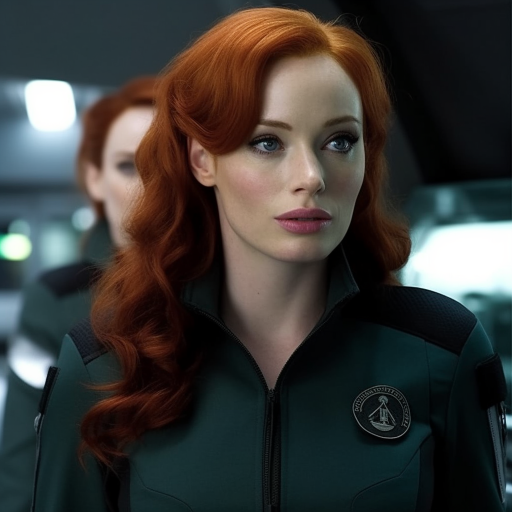
The hum of the Valhalla’s environmental systems filled the air as Órlaith walked through the parting doors of the observation lounge. The Prometheus-class had that same sterile Starfleet smell: a mixture of new carpet, ozone, and chemical cleaners. It was like she never left her ship, except that the Valhalla had that garish esthetic., bright-white late 2370s vessels ended up with.
She shrugged, smirking to herself. Still, it’s better than the current trend where all the ships are stuck in perpetual twilight. Whose not-so-genius idea was to give starship bridges mood lighting? It’s work, not a romantic dinner.
Commander Hayden, Lt. Commander Swiftblade, and Lieutenant MacDonald flanked her as she took in the room. The Valhalla’s senior staff was already seated around a white-framed conference table with an inlaid black glass surface. A row of floor-to-ceiling windows followed the rear contour of deck one, offering a clear view of the glowing quad nacelles jutting from the dorsal spine of the ship. Starfleet refused to call it a warship, but it had been built for one purpose, and that purpose was fighting the Dominion.
Vance stood and rested his palms flat at the head of the table. “Welcome aboard, Hindenburg.”
Rolling her eyes, she resisted the urge to call him “Lucky Vance,” though that wasn’t an insulting moniker like her own. He really did have an inordinate amount of luck on his side.
“Thank you, Captain,” she muttered as she slid into one of the open seats between the Valhalla’s chief engineer and helmsman.
The rest of her crew found open seats around the table; it was a packed house. Vance entered commands into the control pad on the table’s surface, and a holographic display of the second planet in this backwater system shimmered into existence above them, slowly rotating. Another series of beeps from the control pad, and the rocky debris field materialised in orbit around the planet, with dozens of yellow, pulsating dots representing the orbital platforms appearing within it.
“Using the Sentinel’s sensor logs and several probes, we were able to map the orbital platforms and get some idea of strength and design,” Vance said. He delivered the whole line without taking his eyes off Órlaith. She understood exactly what that look meant. She had ignored his orders, rushed in, and the Sentinel had paid the price. He wasn’t wrong either.
Órlaith swore silently and stared down at her reflection in the black glass of the table. Her jaw tightened until it hurt. That silent disapproval was worse than getting yelled at. She closed her eyes, took a centering breath, blew it out through her nose, and sat up defiantly. She had messed up, but she needed to own it.
Hell, most of this sensor data is from our scans. We learned some valuable data, and nobody died. The ship can be fixed, she told herself.
“Metallurgical scans from one of our probes before it was destroyed gave us some fascinating insight,” the Valhalla’s Andorian science officer said. Shrin’s antennae twisted as she entered commands into her control pad. The planet shimmered away, replaced by a golden model of the alloy’s composition, with its bonds and elements rotating in the air. “This is a unique alloy not seen anywhere in the galaxy. It appears to share some Iconian smelting techniques, but it also combines tritanium with specific ratios of copper and tin.”
“You are saying they added bronze to tritanium?” Lieutenant Washington asked from beside Órlaith. “Why would they do that? It should weaken the structure. Sure bronze doesn’t rust, but it’s space. There’s no oxidation. The crystalline lattice shouldn’t work for a hull.”
“I do not know,” Shrin said, “but isotope analysis suggests these orbital platforms are over fifteen hundred years old.”
“You should have led with that,” Commander Kyle said with a smirk. “Hull material is one thing, advanced tech in the period after the Iconians and T’kon Empire is a fascinating xenoanthropologocal turn of events. Though, I admit as an engineer I find the technology interesting as well.”
“Fer the bronze I think I ken why. Our sensors arenae tuned tae bronze alloys,” Dougal said. “No’ that we cannae detect ’em, mind ye, but when the tactical station scans an area, it’s built tae look for ship hulls, engine signatures, an’ weapon systems. It tunes out all the rest tae speed up analysis an’ threat assessments. We’re talkin’ thousands o’ petabytes o’ data flyin’ past, the last thing we need is tae bog it down wi’ every bit o’ space rubbish floatin’ about.”
Vance cleared his throat and grunted with appreciation, as if the old warrior respected the trick. “Sneaky bastards,” he said with an amused expression. “Camouflage.”
“That means there were probably more originally,” Valhalla’s security chief, Lieutenant Villaseñor, added with a wry smile. He sat back and folded his hands in front of him. “But I don’t see a power source in that schematic.”
Shrin frowned, “As far as I can tell, there isn’t one. They appear to have a remote power source.”
“I can answer that,” Audrin said, taking over. She switched the holographic display back to the planet. A glowing red dot appeared on the northern continent. “That is the energy signature that originally brought the IKS H’poc to the system.” She entered a command, and the planet zoomed into an aerial surface scan, revealing a complex of buildings partially hidden by a forest that was slowly reclaiming the site, tree by tree and vine by vine. “The source is located at this site. There appears to be some sort of artificial singularity reactor.”
“Romulan?” Kyle asked with an eyebrow raised.
“No, I don’t believe so. The harmonic signatures are not the same. It’s most likely just a convergence of technology,” Audrin said.
“So let me get this straight,” Kyle started. “They are remotely powered, hidden from sensors, and automatically target anything that gets close to the planet. So how do we deal with it?”
The officers sitting around the table glanced at each other. Órlaith bit her lower lip. She didn’t want to abandon Hur’agha, but they were outside of transporter range, and when a ship moved into orbit, they got mauled by a weapons platform that had more firepower than a fleet of starships. Those polaron beams still ate Starfleet shields for lunch.
“At Chin’toka the Defiant painted a Federation warp signature on the reactor facility and its own weapons turned on it,” Vance grunted as he tapped his index finger against the polished surface with a meaty thump, thump.
“Och aye, but that was a bloody moon. In this case, it’s on a planet with an atmosphere. That’s no possible ta paint it on the surface..”
Anthony had been sitting with his elbow resting on the table, a chip pinched between thumb and forefinger, and looked up from his thoughts. “What activates the defenses?”
“It wouldn’t be practical to target and destroy every bit of space junk that closes on the planet. All indications suggest that it’s the high energy output of a starship, probe, or torpedo,” Audren said.
“Now that we know what we are looking for, why don’t we pick off the platforms one by one, Villaseñor suggested.
“You might get one—” Audrin started.
“But, that will activate the rest of the wee buggers, and in order for us ta be out of weapons’ range, we are giving them time to target and destroy our torpedoes, an’ we are out of phaser range lad.”
“Precisely,” Audren agreed.
“So we can’t beam down. We can’t get them to destroy their own power source. We can’t snipe them.” Erin lsat back and steepled her fingers. “That leaves shuttles.”
“Which will be destroyed like our probes, the H’Poc, and very nearly the Sentinel,” Kyle countered.
“Maybe there is a way,” Anthony offered.
“Mr. Talon, this isn’t one of your broncs where you can grit through the ride,” Kyle tried shutting him down.
The young helmsman only grinned wider, undeterred. “Actually, Commander… it kind of is.” He leaned forward. “Think of the Apollo missions. They hit Earth’s atmosphere on nothing more than math, a ballistic trajectory, and a heat shield. So we get a running start, kill power, drop into the upper atmosphere in passive mode, and punch the deflectors right before thermal failure. Once we’re through the worst of it, we power up and make a landing. If the platforms shoot at us, we’re close enough to beam out.”
Across the table, Dougal muttered, “Lad, ye’ve got more guts than sense.”
“That’s not a bad idea,” Vance said. Faces from both crews shot to the Valhalla’s captain, their jaws slack and eyes wide. “But I’m not risking crew, hoping those platforms ignore you in the atmosphere. Better to beam down and sacrifice the shuttles themselves.”
Órlaith shook her head and cocked an eyebrow at him. He had just finished berating her for damaging her ship, and now he’s willing to treat a shuttle like a takeout box. “And what does that accomplish? Then we’ve got a Klingon crew and an away team stranded on the surface.”
Anthony lifted his chin, confident now. “Ma’am, we’re not landing just anywhere. We’re going to,” He pointed at the holographic image of the reactor facility. “We shut it down. By any means necessary.”
“Aye,” Dougal said, rubbing his hands together. “Well then, we’ll need explosives. Good ones. I’ll get with Vogler an’ pick the proper fireworks.”
“This is insane.” Kyle looked around the room seeking allies. “We can’t be seriously considering this? I’m sorry, we have a duty to rescue our allies, but we don’t even know if there are survivors, and we are going to risk the lives of an away team? This isn’t an option, it’s a suicide mission.”
“Two teams,” Órlaith said. “Two teams and two shuttles.” She let out a long sigh. “As you said, Commander, this is ‘insane,’ and we can ill afford to put all our eggs in one basket. One team goes for the reactor, and the other seeks out survivors of the H’Poc. And if everything goes to hell… well, there’s a backup to get the defensive grid disabled so the ships can move into orbit.”
“That sounds like the best plan we have,” Vance said with a nod to his fellow captain. “Kyle, Villaseñor, Shrin, Washington, Talon, and a security team will be on the shuttle to disable the defenses.”
Kyle didn’t look happy, but she nodded. “Yes, sir.”
“Liz,” he said to her. “This is the technical part. Your engineering background will assist Washington.”
“Of course, sir.”
Órlaith stood, and Erin, Audrin, and Dougal followed her lead. “I will get my team assembled for the rescue of the Klingons. When do we need to be ready?”
Vance glanced at Washington, who just shrugged, “Let’s plan on 07:00 tomorrow. It will give engineering time to prep the shuttles.
Nodding, Órlaith started for the door, but Vance stopped her.
“Captain Murphey, I know you want to be a part of the team. Hell, I want to be a part of the teams too. We don’t have that luxury to play cowboy. You are not to be on that other shuttle captain. Am I clear?”
Órlaith clenched her jaw, and after a heartbeat, she nodded, “Yes, sir. Of course, sir.”
She turned on a heel, and a little sharper than intended, and she could feel the back of her foot grinding into the back of her boot before stepping into the door sensor arc, and the lounge’s doors parted with a pneumatic hiss, and she stepped through.
Tell me what I can and cannot do on my own mission,” she seethed to herself. Deep down, however, Vance was right. Her place was on the bridge. That was her responsibility. She was finding that the longer she served in the center seat, the less she liked it, but she accepted the role; it was hers to fulfill. She was no longer that hotshot fighter pilot in a fleet that no longer needed them.